AI Search Promotion: How a Site Made It Into ChatGPT Answers

AI search promotion, also known as GEO, is currently sold as a service with guarantees: "+120% traffic from AI search," "guarantees written into the contract," from 29,000 rubles a month. We don't offer guarantees, but we do have an observation: in October 2026, two leads came to the site tagged utm_source=chatgpt.com. Two leads prove nothing, and there will be no "how to get into ChatGPT" conclusions here. What there will be is the mechanics of how that tag reached us, a list of what was already on the site before this, and a list of what we don't know. The one practical takeaway: how to set up tracking so leads from AI assistants are visible.
Short answer
A site can end up in ChatGPT answers without any dedicated AI work: in October 2026, two leads tagged ChatGPT came to meermost.site, one through the calculator and the other through the contact form, after which the person called on their own. We don't know what query was asked, and two leads aren't enough to judge the method. What you can do on your own site: be in the index, answer questions directly, don't hide facts behind verbiage, and track traffic in a way that makes visits from AI visible.
How we spotted traffic from ChatGPT: the tag and the first touch
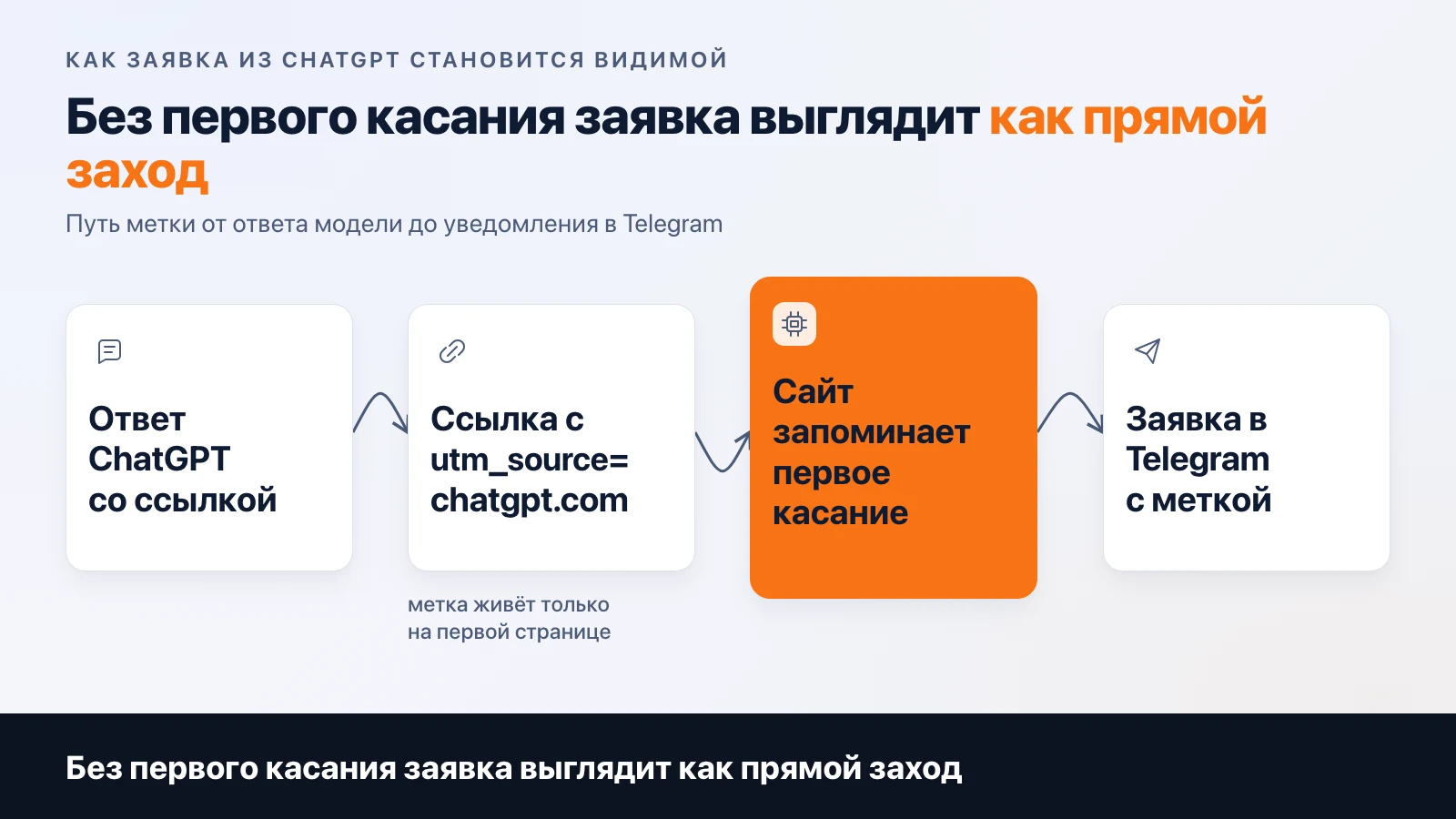
ChatGPT appends a utm_source=chatgpt.com tag to links in its answers. A person clicks, lands on the site with that tag in the address, and then moves through pages without it. If you do nothing, the tag is lost on the very first navigation, and a lead from the third page looks like a direct visit.
On our site, the first touch is preserved: the tag from the address is written to the browser session on the first visit and is never overwritten. When someone submits a lead or runs a calculator estimate, the tag goes along with it into the Telegram notification. An example of what such a notification looks like, with no extra fields:
[meermost.site]
Расчёт калькулятора приложения
• Платформа: iOS + Android
• Функции: Сложные
• Дизайн: Кастомный
• Бэкенд: Не нужен
• Сроки: 1–2 месяца
Вилка: 1 250 000 ₽ – 1 760 000 ₽
utm: source=chatgpt.com
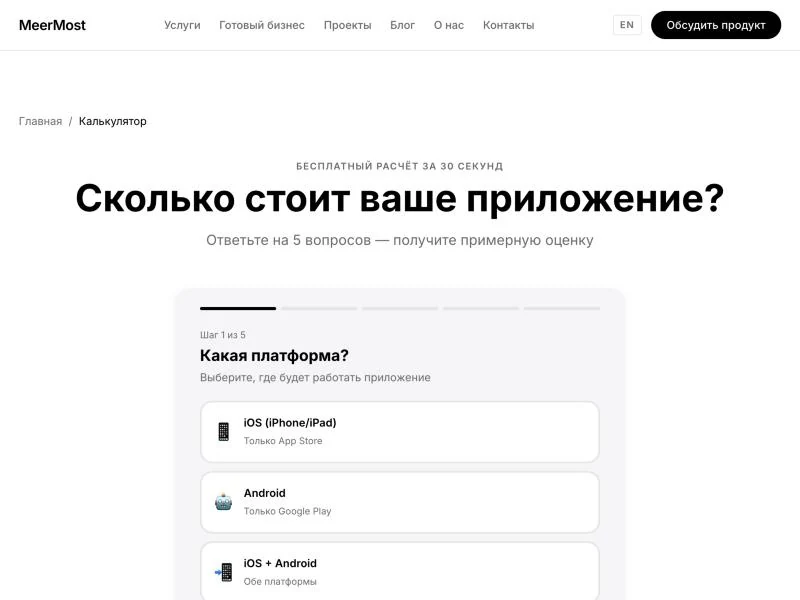
A five-question calculator. The estimate goes to our chat anonymously, with the first-touch tag if there was one.
The second lead came in on October 21 through the contact form with the same tag. The person described the project in one line and called on their own a few minutes later. I won't share the name or the subject here.
Two caveats so this doesn't look neater than it is. First: one Western analytics report says that as of October 9, 2026, ChatGPT stopped putting this tag on links; on October 13 and 21, the tag was still there for us. Either it didn't affect everyone, or it didn't affect all answers. Second: according to the same analysts, the ChatGPT mobile app doesn't pass a referrer, so visits from there can't be told apart from direct ones without a tag. How many of those there were, we don't know.
What was already on the site before these leads
A list of what was on the site by October, without judging which of it worked. It can't be treated as a "how to get into ChatGPT" plan: every item was there for regular search and a live reader.
- The
llms.txtfile at meermost.site/llms.txt: services, ready-made business, and articles as a single text with links. It's built from the same translations as the pages, so it never falls out of sync with them. - robots.txt with an explicit allow for 19 bots by name: GPTBot, OAI-SearchBot, ChatGPT-User, ClaudeBot, PerplexityBot, and the rest. The
User-agent: *rule lets them in anyway, but some operators read the absence of their own name as a soft refusal. - A Q&A block on the ready-made business page and in articles, marked up with FAQPage.
- A direct answer right after the main subheading in articles, before any reasoning. This is a rule from our SEO article pipeline, and it works the same way for a search snippet and for a quote in an AI answer.
- Prices on service pages and calculators that show a range instead of "leave a request and we'll work it out."
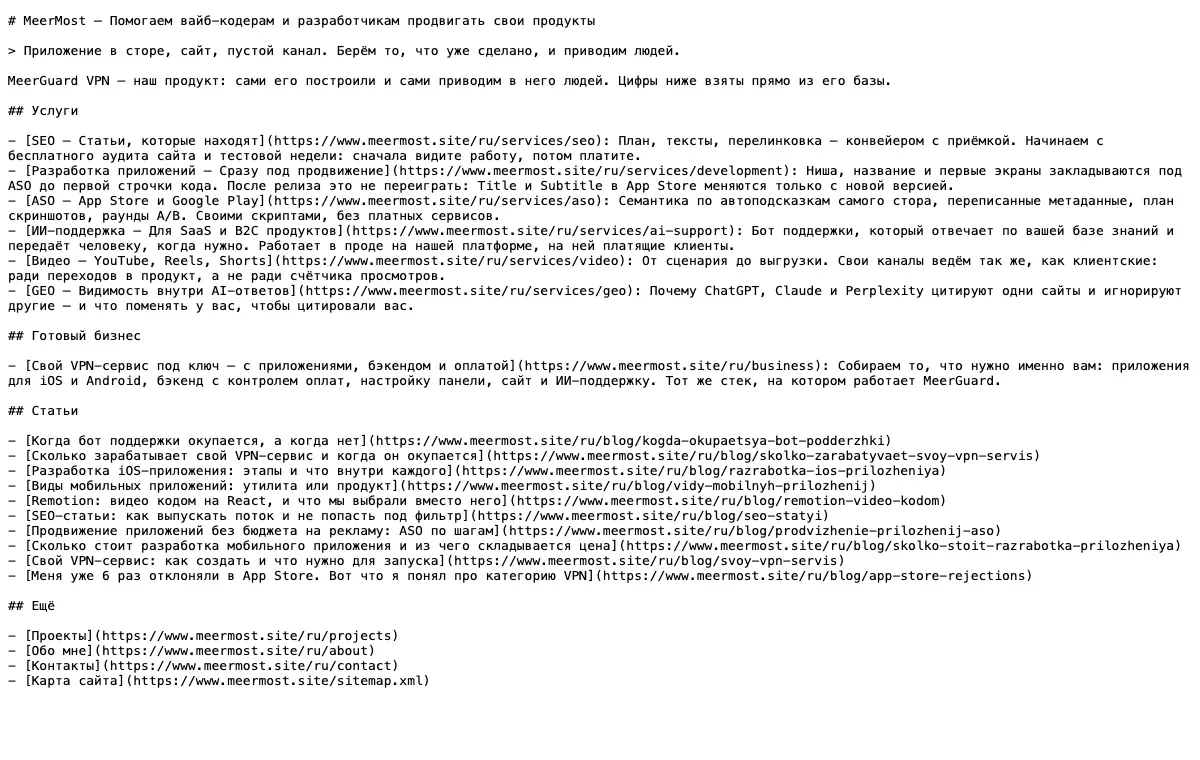
The whole llms.txt fits on one screen. It isn't a standard or an obligation, it's the cheapest way to be understandable to an assistant: one page of code and zero maintenance.

The site's robots.txt: every bot is named separately, even though the general rule lets them in anyway.
Not a single item on this list is proven to be the cause. The first lead came through the app cost calculator, and it's logical to assume ChatGPT was answering a question like "how much does app development cost," where the site has an article with open pricing. But that's an assumption, not data.
What GEO Is and How It Differs from SEO
GEO (generative engine optimization) is the work of getting a model to name your product in its answer. It differs from SEO in the result, not the methods: in search you get a position in a list of ten, in a model's answer you get a mention in a list of two or three, or nothing at all. There's no middle ground.
The foundation is the same, though. In search mode, ChatGPT pulls pages from the web index, and a site that isn't there won't be in the answer. So "AI promotion without SEO" is selling the second floor without the first. What gets added on top: answers to questions in plain text that can be quoted without losing the meaning, facts and numbers instead of "reliable and high-quality," and mentions on third-party sites that models draw data from.
How to Check Whether AI Names You
We don't have our own measurement tool — we do it by hand, and that's stated on the service page. Here's the process:
- Write down 10–15 questions your customer asks: "how much does X cost," "which X should I choose for Y," "the best X in 2026."
- Ask each one in ChatGPT, Perplexity and Alice, in search mode. Write down who got named.
- Repeat a week later: answers fluctuate, one run isn't enough.
- Open the sites that were named and compare them with yours: do they give a direct answer to that question, a price, a table, an FAQ?
- Check that your site is even in the Bing and Google indexes for these queries.
The fifth point rules out half of all "they don't mention us" cases: the site simply isn't in the search results, and it has nothing to do with AI.
How to Track AI Traffic on Your Own Site
To see leads from ChatGPT you need three things, and none of them are about AI.
Save the first touch. The tag lives only in the URL of the first page; if the site doesn't remember it, a lead that arrives three clicks later will come in with no source. On our sites that's a record in the browser session that never gets overwritten.
Pass the source through to the lead. Into the lead notification, into the CRM, anywhere someone will look at it later. Metrica and GA4 will show you visits, but they won't tell you which one turned into a lead.
Set up a separate source in your analytics. In GA4 and Metrica, referrers like chatgpt.com, perplexity.ai and similar can be pulled into their own channel; otherwise they dissolve into "referral traffic."
What We Can't Promise
A table of what we know and don't know about these two leads. It's more honest than any case study with percentages.
| We know | We don't know |
|---|---|
| The date and tag of both leads | What query the person asked ChatGPT |
| Which page each one came through | Which page ChatGPT cited |
| What was on the site at that point | What of it made the difference |
| That the tag was being set on our end in October | How many visits came without a tag, from the app |
| That both leads were about development, not VPN | Whether they'll become clients |
That's why the service page says "price on request" and "we don't have our own tool yet." An agency that promises a growth percentage in the contract is promising something it doesn't control. What it does control: edits to the site, pages with facts, presence on third-party platforms, and re-measurement. That's the work, and it can be priced. The result in the model's answers can't.
Checking visibility across several models is free with us: we run your product and your competitors through typical queries and show who gets named instead of you and why. After that come the site edits from the list above and another measurement. No percentages in the contract.
Frequently asked
Can you guarantee that a site will show up in ChatGPT answers?
No. The answer is generated from scratch for every query and can differ from person to person. A promise like "+120% traffic from AI search" can't be verified before or after.
How can you tell that someone came from ChatGPT?
By the utm_source=chatgpt.com tag in the page URL or by the chatgpt.com referrer. According to analysts, the ChatGPT mobile app doesn't pass a referrer, so those visits look like direct traffic in your analytics.
What is llms.txt, and is it required?
A text file with a map of the site for assistants: services, articles and links in one list. There's no standard and no requirement, and no bot is obliged to read it. We have one; there's no way to measure what it actually contributed.
Where does ChatGPT get the sites for its answers?
In search mode, from the web index. Bing is usually named as the main partner, but OpenAI doesn't publish the details. So regular SEO remains the foundation: a site that isn't in the index won't make it into an answer.
What of what was done on the site actually worked?
We don't know. The tag doesn't pass along the query the person typed into ChatGPT, and two leads aren't a sample. We can list what was on the site at that point, and that's it.
Related articles

SEO Articles: How to Publish a Steady Stream Without Getting Hit by a Filter
How an SEO article pipeline works: where to source topics, how to pick clusters, why the ceiling is 8–12 articles a month, and why a human reads every one before it goes live.

The cobbler finally got his shoes: how I built my portfolio site after 3 years of client work
For three years I built websites and apps for clients while having no site of my own. A breakdown of the meermost.site architecture: Next.js 15, i18n, a markdown blog, and calculators as SEO pages.

AI in a Mobile App: How to Integrate ChatGPT
AI in a mobile app: the API key stays on the server, per-user limits, caching, moderation and a token-based cost estimate. Meerno as the example.