Generating Articles with AI: What Passes Review

Generating articles with AI gives you a draft in minutes and mistakes in the same minutes: invented "our tests", promises of features that do not exist, links to pages that do not exist. Below is what a model does well in an article, where it breaks, and what review by a human cuts out. The numbers come from the panel of our SEO factory, where a model writes drafts and a human reads them.
Short answer
AI is good at assembling a structure, shortening text and proofreading it against a checklist. Facts, numbers, links and product capabilities it produces without checking. A text passes review when every such item is checked against a source and a third of the article is something the model has nowhere to get: your own data, product mechanics, honest limitations.
What the model does well
It really saves time on four things. The first is structure for the query: headings from sub-queries, the order "answer first, then the breakdown", a draft FAQ from questions in the results. The second is a summary of the results: from five other people's articles, write out what everyone covers and what nobody has. A human still opens the pages, but the model builds the "what the top has" table faster.
It also shortens: it cuts a long sentence in two and brings a paragraph down to one idea. And it proofreads against a checklist of stop words, "not X, but Y" and even lists of three items. The checklist is mechanical, and the model does not get tired.
What follows is what is dangerous in a text precisely because it looks convincing.

Where AI breaks
| What breaks | What it looks like in a draft | What we do |
|---|---|---|
| Numbers and sources | A round number with no export, "according to experts" | A number without a source and date does not go into the text; it goes on the "to check" list |
| First-person experience | "In our tests...", although there were no tests | Remove it, or replace it with a measurement we can show |
| Product capabilities | A feature is described that does not exist, or it is switched on differently | Check against the code and the interface |
| Links and tags | A blog page that does not exist; a plausible UTM tag | Addresses only from the project's link registry, otherwise TBD |
| The horoscope paragraph | Text that would suit any niche | Fill it with our own material or delete it |
Every row has a case in the factory queue. On 31 August 2026, during review of a technical article, "in our tests" was removed (there were no tests), along with a promise that the needed mode is switched on by a toggle in the app: it is configured on the service side. On 7 October 2026 we found on the site a link to a blog page that does not exist and a promise of an installation file that is not in the releases. The model did not lie on purpose. It wrote what is usually written in such articles.
A separate kind of error concerns how data is shown. On 30 October 2026 the owner asked to present calculation results as percentages instead of counters like "N of M": the reader needs a share, and raw counters stay in working documents. The model will not write this on its own, because the rule exists only in the owner's head and in our rule registry.
What a horoscope paragraph looks like
A typical draft writes: "Choose a reliable contractor with good support and transparent terms." It suits a dental clinic, a pizza delivery and app development equally, so it says nothing. Review sends such a paragraph back with one question: what here can be checked?
A working version names something checkable. For example: ask the studio for a specification with a fixed price and deadline before the start, not after the first stage. Or open the store profile and see whose account the previous apps were published from. The model knows such things only in general terms. The specifics come from the studio's practice, and they must be written in by someone who has that practice.
What the review data shows
The panel stores the status of a card and the reviewer's last comment. It does not record the history of transitions, and that limits what can honestly be counted.
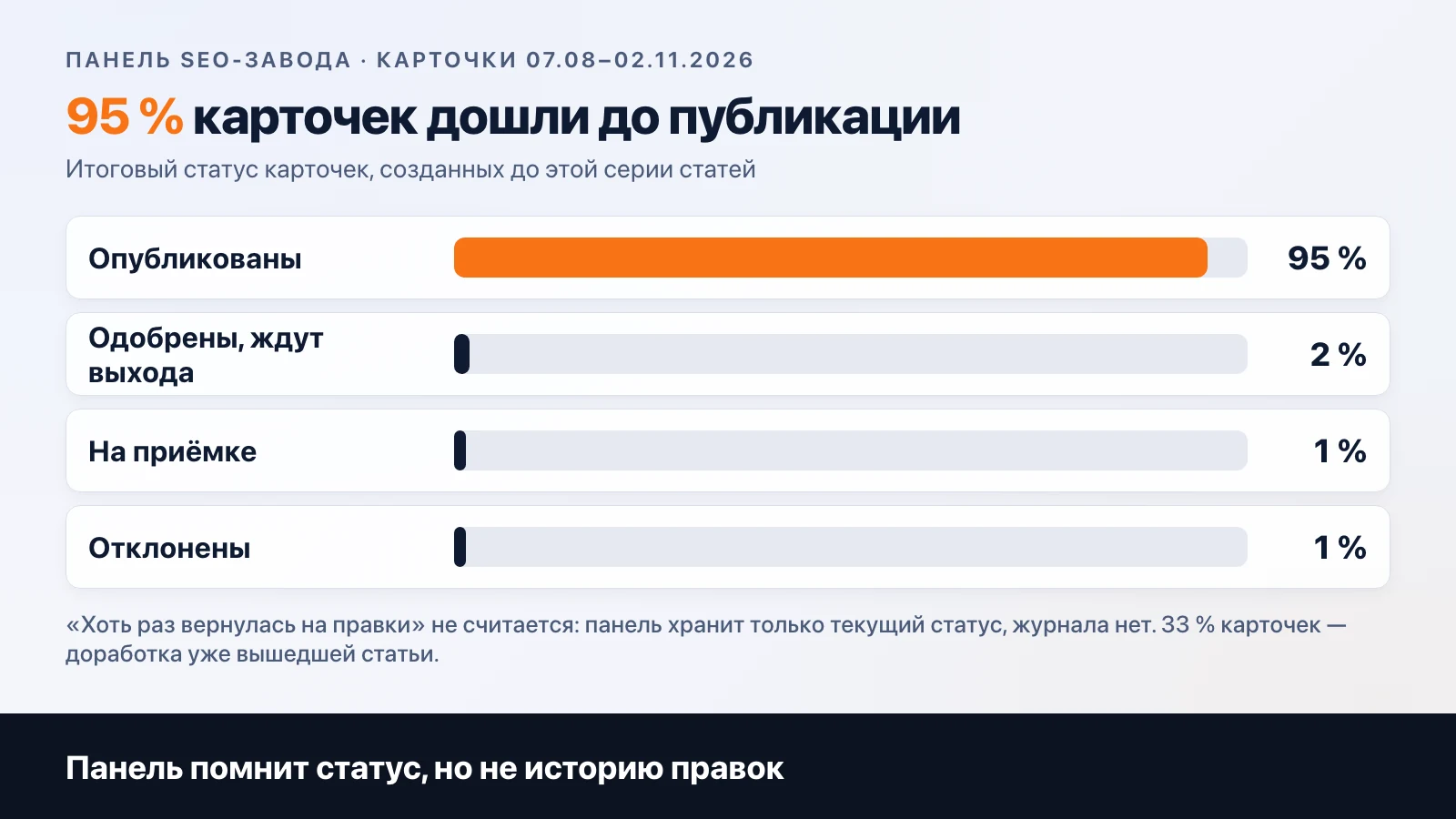
Snapshot as of 10 November 2026: cards created from 7 August to 2 November 2026, before this series.
| Status | Share of cards |
|---|---|
| Published | 95% |
| Approved, waiting for release | 2% |
| In review | 1% |
| Rejected | 1% |
The single rejected card was closed for a reason unrelated to text quality: the topic became inadmissible on legal grounds, and the owner withdrew the article. The share of cards that "came back for edits at least once" cannot be calculated from this data: the panel has no log, and right now 0% are in edits. The review comment is preserved on about 1% of cards, and it is the very one that was withdrawn. The traces of real edits are in the factory queues. Until there is a log, we do not name this share.
One number can be counted exactly: a third of the cards (33%) carry the mark "revision of a published article" (EDITED).
The queues point to two typical reasons for edits:
- Facts and promises: what is in the table above.
- How data is presented: percentages instead of counters (30 October 2026).
The lesson for working with a model is simple: a fix from one article is checked across the whole series at once.
What search engines say
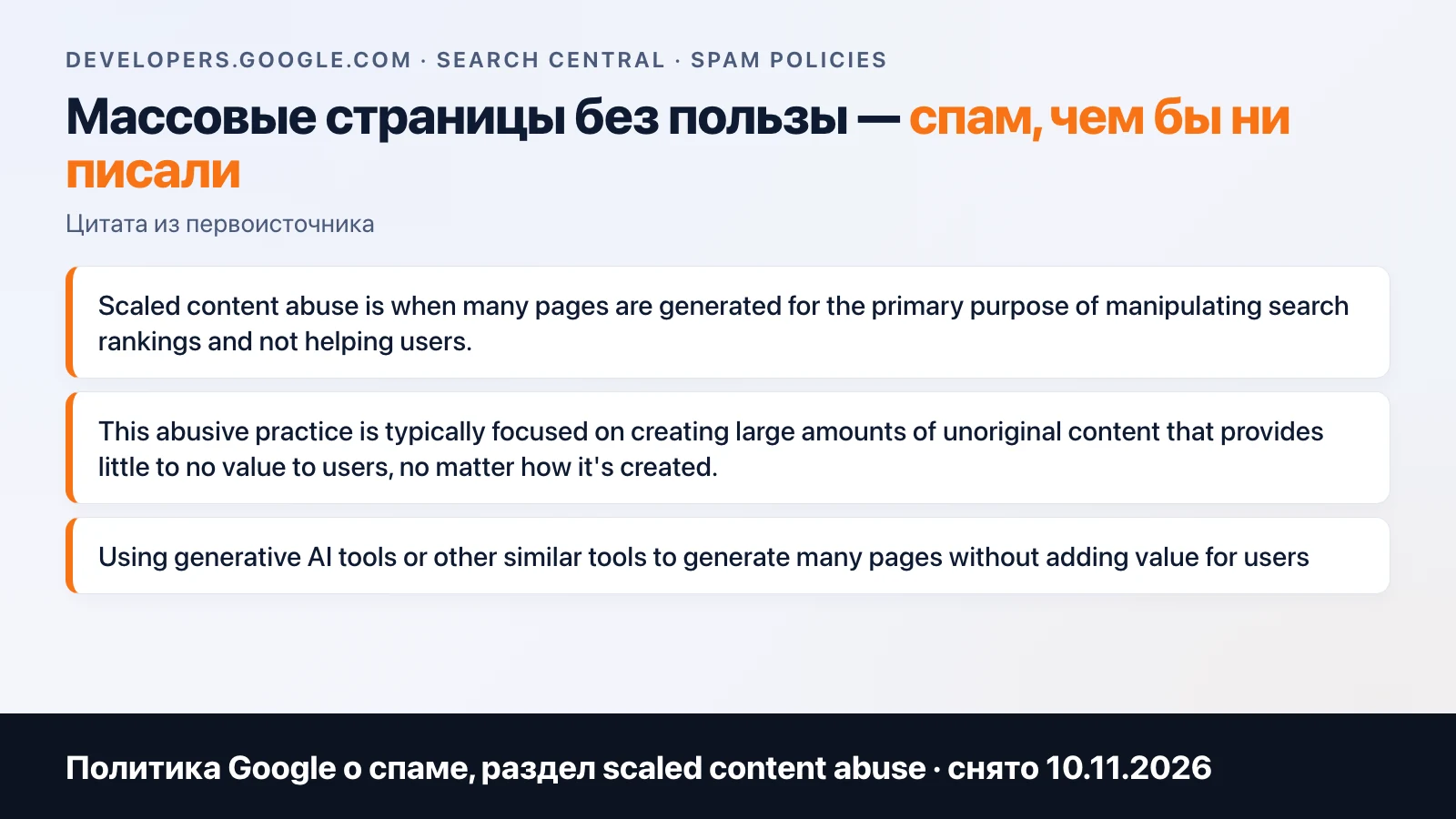
In its rules Google talks about scale and usefulness; the way a text is created is not penalised separately. The spam policy defines "scaled content abuse" as generating many pages for the purpose of manipulating search results, typically a large volume of unoriginal content that provides little to no value to users. The phrase "no matter how it's created" is there: the way of creation does not change the assessment. The examples directly name using generative AI for many pages without value for people (Google Search Central, spam policies, page read on 10 November 2026, no update date on it).
A separate page on generative AI advises manually checking facts and reviewing all generated material before publishing, including the title, description, markup and alt text (Google Search Central, generative AI, 10 November 2026). This is the same thing that review does.
Yandex has a close concept called low-value content. According to the Webmaster help, this is material that gives the user no additional value. Among the signs the help names text created by a neural network, machine translation or templates without analysis and editing, and unverified facts presented as reliable (Yandex Webmaster, low-value content, page read on 10 November 2026). This page does not describe consequences.

Many figures about "losing 50–80% of traffic" circulate online. We did not find a primary source, so we do not cite them. Sanctions for mass-generated pages exist, but how much traffic is lost to them has not been reliably measured.
How we check a generated article
The whole pipeline, from choosing a topic to the revision after 90 days, is covered in the article on the SEO pipeline. Here is only what a human does with a text that is foreign to them.
- For every number: where it comes from and for what period. No answer, and the number comes out.
- Open every link, even if the address looks right.
- Find every product capability in the code or the interface.
- Apply the horoscope test to each paragraph: would it suit a competitor in any niche?
- Count the share of your own material: product mechanics, screenshots, limitations, questions from support. Less than a third, and the article goes back.
- A fix found in one article is checked across the whole series.
The model does none of this for the human. It can suggest where to look and re-read after an edit.
If you need such a process
We run SEO promotion with articles: a free site audit and one test article from plan to publication, and then you decide. Write-ups on how we work in practice come out in the Telegram channel. We do not guarantee positions.
Frequently asked
Can I generate website articles with AI?
Yes, if a human reads and checks the article. Google does not ban generative AI: its scaled content policy targets mass production of pages that give the user nothing new, regardless of how they are created. Generated text must be checked manually for facts before publication.
Will Google penalise articles written by AI?
Not for the way they were written. The rule on "scaled content abuse" describes pages created mainly to manipulate search results: a lot of similar material with no value. The policy describes mass pages with no value; it says nothing about a single edited text.
What mistakes does AI make most often in articles?
It invents numbers and first-person experience ("in our tests" when there were no tests), promises product features that do not exist, links to pages that do not exist, and writes paragraphs that would fit any niche.
How do I check an article written by AI?
Go through every number, link and described product capability: find the source, open the page, check against the code or the interface. Then read each paragraph and ask whether it would suit a competitor in any niche. If yes, the paragraph is filled with your own data or deleted.
How much of the text should be our own rather than common knowledge?
We hold the bar at a third of the article: the mechanics of your own product, your own screenshots, limitations, a breakdown of frequent requests. This is the factory's internal rule, not a requirement of search engines.
Related articles

How to Write a Website Article That Brings in Clients
How to write a website article that brings leads: topic by demand, one cluster per page, a direct answer up top, your own data, a link to the service.

SEO Articles: How to Publish a Steady Stream Without Getting Hit by a Filter
How an SEO article pipeline works: where to source topics, how to pick clusters, why the ceiling is 8–12 articles a month, and why a human reads every one before it goes live.

AI Search Promotion: How a Site Made It Into ChatGPT Answers
GEO without promises: two leads from ChatGPT in October 2026, the tag that makes them visible, what was already in place on the site, and what can't be guaranteed in AI search promotion.