How to Write a Website Article That Brings in Clients

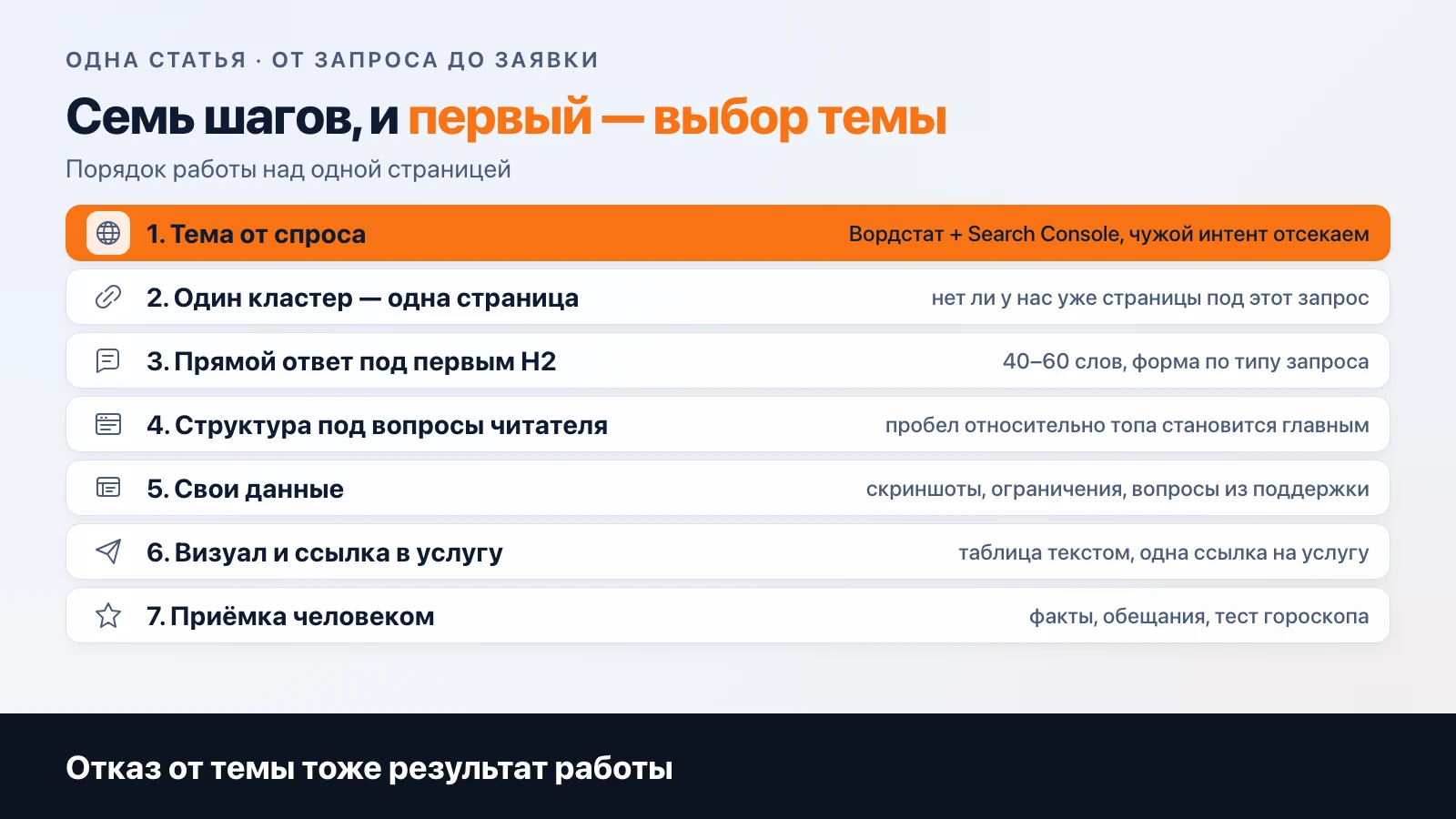
How do you write a website article that brings in clients? Most of the decisions are made before the first line of text: what to write about, for which query, and where to lead the reader afterwards. Below is the order in which we write articles on this site, with real numbers from Search Console and our topic queue. How the whole article pipeline works, the monthly ceiling and the revision, is described in another article; this one covers a single page.
Short answer
- Choose the topic by demand: check the phrases in Yandex Wordstat and Search Console.
- Give the page one query cluster; no second article on it.
- Under the first heading, a direct answer of 40–60 words; then follow the reader's questions.
- Add your own data, one visual and a link to the service.
- Have a person proofread it before publishing.
Demand picks the topic
Check a topic against two sources. Yandex Wordstat shows how many people search for a phrase per month. Search Console shows which queries your site already appears for in Google, and at which positions.
Here is our own data. Over the 90 days to 10 November 2026, meermost.site had 151 non-brand impressions and 6 clicks. Of these, 87 impressions (58%) came from Remotion queries: the site sits at positions 6 to 9.3, which is the bottom of the first page. Clicks on them: zero. We do not know why: the sample is small and we have not yet looked at the snippets. That is a line on the revision list. It is too early to draw a conclusion from such a sample: 87 impressions at positions 6–9 can bring zero clicks without a single mistake in the article.
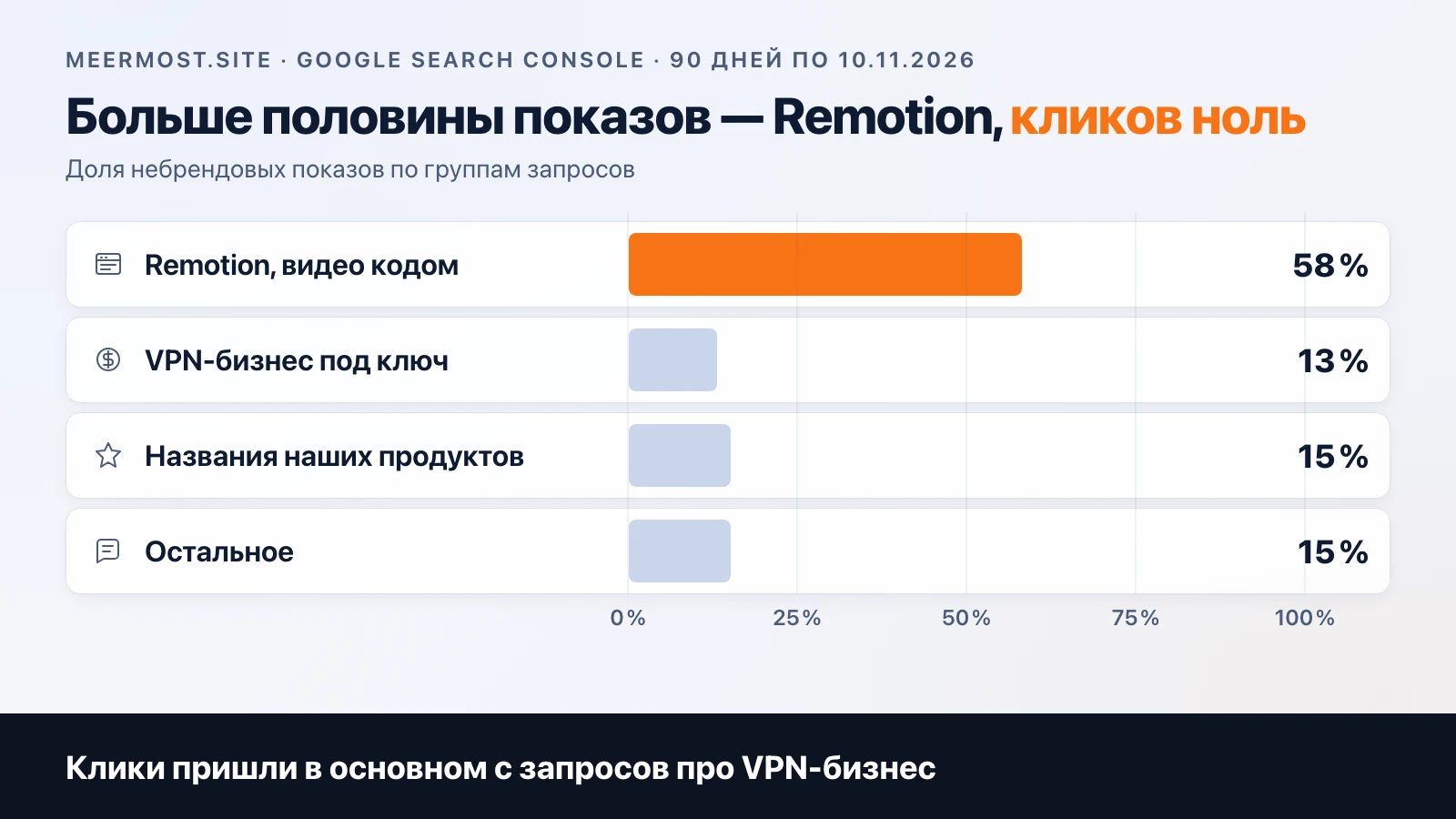
The opposite happens too. The query «впн под ключ» ("turnkey VPN") brought 7 impressions and 3 clicks at position 6.7. Seven impressions are not enough for conclusions, but there is already a topic for an article next to a service we sell.
When to drop a topic
A big number in Wordstat promises nothing. The query «заказать приложение» ("order an app") collected 46,957 impressions a month (Wordstat, 13 August 2026), the largest figure in the export for our niche. We rejected it: people search for how to order a taxi, food or a bank card through an app. The intent is someone else's. We kept the entry in the queue with the reason and the date, so that six months from now we do not spend a week on it again. A second example of rejection, with agencies in the top results, is covered in the article on the pipeline.
One cluster, one page
Two articles for one query will compete with each other. So before writing we check whether we already have a page for the cluster.
This article targets «как написать статью для сайта» ("how to write a website article", 440 impressions a month) and «написание статей для сайта» ("writing articles for a website", 564). We deliberately skip «статьи для сайта» ("articles for a website", 12,538) and «сайт для статей» ("a site for articles", 12,748): people use those to look for platforms and other people's texts. Wordstat data for Russia, collected on 10 November 2026.
The title and the first hundred words
The target query appears in three places: the page title (up to 60 characters), the H1 and the first hundred words. The meta description (up to 160 characters) is written for a person: what they will get and why to click. It does not affect ranking, but it decides whether your snippet gets clicked. To check, we look at the results with our own eyes: if your title looks like the one next to it, the reader has no reason to choose yours. So it is better to put into the title what only your article has: a number, a limitation, a comparison.
The introduction takes one or two sentences and says right away what the reader will get. A backstory about "in today's world content is everything" is needed by no one. Both the reader and the editor cut it first.
A direct answer under the first H2
A reader coming from search does not want a run-up. Under the first H2 we put an answer to the query in 40–60 words: the snippet takes it, and AI answers quote it. The form of the answer depends on the question:

- "how to do it": a numbered list;
- "what is it": a paragraph;
- "what to choose": a table.
The structure then follows the sub-questions. Open the results for your query and write out the headings of three top pages and the "People also ask" block. What everyone covers, you take into the text. What nobody covers, you make the main point. For this article the gap is this: going by Google snippets on 10 November 2026, the results have plenty on text length and keyword density, and little on choosing a topic and on dropping one.
Writing like a person: a before and after example
Below is a teaching example invented for this article. A flower shop with these terms does not exist.
| Before | After |
|---|---|
| Our company has been providing high-quality flower delivery services for many years. We carry out delivery in the shortest possible time and have extensive experience. | The bouquet reaches the door in two hours within the city and in a day outside it. The courier calls 15 minutes ahead. A photo of the finished bouquet arrives before dispatch, and if you do not like it, we will make it again. |
The left column has judgements without facts ("high-quality", "shortest possible", "extensive experience"), bureaucratic phrasing ("providing services", "carry out") and an abstraction as the subject. The right column follows Ilyakhov's rules: the subjects are the bouquet and the courier, deadlines replace judgements, verbs replace verbal nouns. Any paragraph can be run through one question: would it suit a competitor? If yes, it is a horoscope. Fill it with facts or delete it.
Your own data: what a neural network does not have
At least a third of the article should be something no model will produce without access to your business. These are your screenshots, your limitations, questions from support, calculator data. Our topic about a panel for a VPN service came from a calculator row: a panel is needed in 82% of calculations for September–October 2026. The calculator export is ours, so the article has numbers that a model does not.
But your own data has to be real. If you have no number, write the mechanics, a scenario or a limitation. An invented case with a client called "Romashka" costs you the trust of the whole site: get caught once, and nothing else is believed.
A visual and a link to the service
For every 700 words you need at least one visual: a screenshot, a diagram or a table. We write a table as text: an image will not be indexed and will not make it into an AI answer.
The link leads to one service page that solves the same problem. It goes in after the reader has understood that they need help; the first paragraph is too early for it. Three to five internal links are enough per 1,000 words. You can link only to pages that are already published.
On length. We keep to 1,100–1,600 words, but we choose the number after looking at the results: if three pages from the top fit into 900 words and answer fully, there is no reason to stretch yours to 2,000. Go longer exactly where competitors have a gap that you are closing.

Review before publication
The last step is a proofread by a person who did not write the text. They check four things: whether every number has a source and a date, whether the text promises something the product does not have, whether every paragraph passes the horoscope test, and whether the article reads aloud like a person speaking. The details of the process and the revision after 30 and 90 days are in the article on the SEO article pipeline.
If you want us to write such an article for your site, the SEO promotion page offers an audit and a test article from plan to publication. First you see the work, then you decide.
Frequently asked
How many words should a website article have?
Enough to answer the query more fully than the pages in the results, with no filler. For our articles that is 1,100–1,600 words. Length is not a goal in itself: a short page with a table and a direct answer often beats a long one with no structure.
How many times should I use the target keyword?
The target query should be in the title, the H1 heading and the first 100 words. After that it appears where it fits naturally. If a phrase sounds wrong read aloud, rewrite it instead of keeping it for a counter.
Can I write website articles with AI?
A draft, yes; publishing without a human, no. A model does not know your prices, limitations or client questions, so the text comes out the same for everyone. We wrote about the limits of a publishing pipeline in the article on SEO articles.
How do I tell whether an article works?
After 30 days, check indexing in Yandex and Google; after 90 days, check impressions and positions for the article's queries in Search Console. Zero impressions after three months: check indexing first, then the topic.
Where should an article lead the reader?
To one service page that solves the same problem as the article. In our case that is SEO promotion. Put the link where the reader has already understood that they need help; the first paragraph is too early for it.
Related articles

Generating Articles with AI: What Passes Review
What AI does well in an article, where it makes mistakes and what a human catches in review. SEO factory panel data for 7 Aug–2 Nov 2026 and Google's rules.

SEO Articles: How to Publish a Steady Stream Without Getting Hit by a Filter
How an SEO article pipeline works: where to source topics, how to pick clusters, why the ceiling is 8–12 articles a month, and why a human reads every one before it goes live.

AI Search Promotion: How a Site Made It Into ChatGPT Answers
GEO without promises: two leads from ChatGPT in October 2026, the tag that makes them visible, what was already in place on the site, and what can't be guaranteed in AI search promotion.