Taking payments in a Telegram bot: Stars, YooKassa, SBP, or crypto
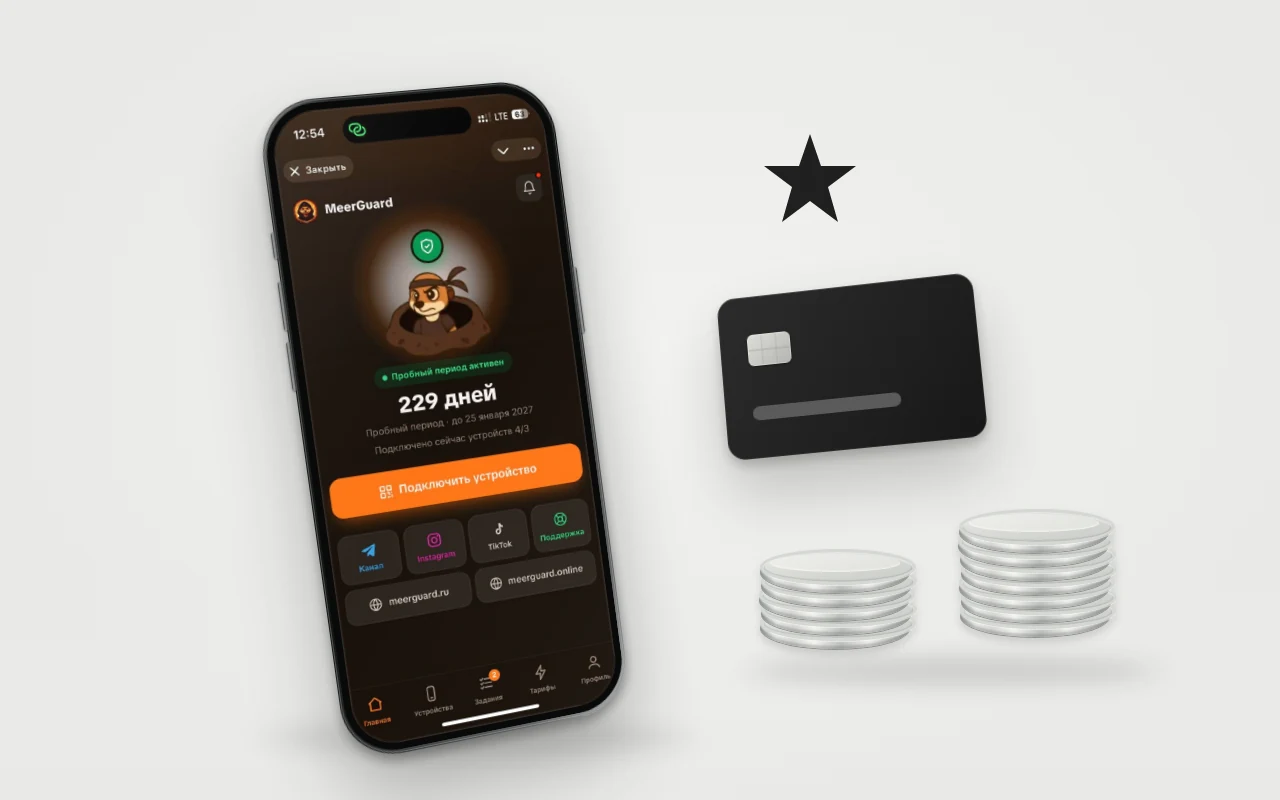
There are four ways to take subscription payments in a Telegram bot: Telegram Stars inside the bot, a ruble payment provider that handles cards and the Faster Payments System (FPS), crypto, and services like Tribute. In our VPN service calculator, people select the "Telegram payment" line in half of all calculations, and almost everyone who comes to us with it asks the same thing: what to hook up and how much it will cost. Below: the four methods in one table, the Telegram rule that Russian articles paraphrase but never quote, and the payment shares from our bot, where all four methods have been live for a year.
The short answer
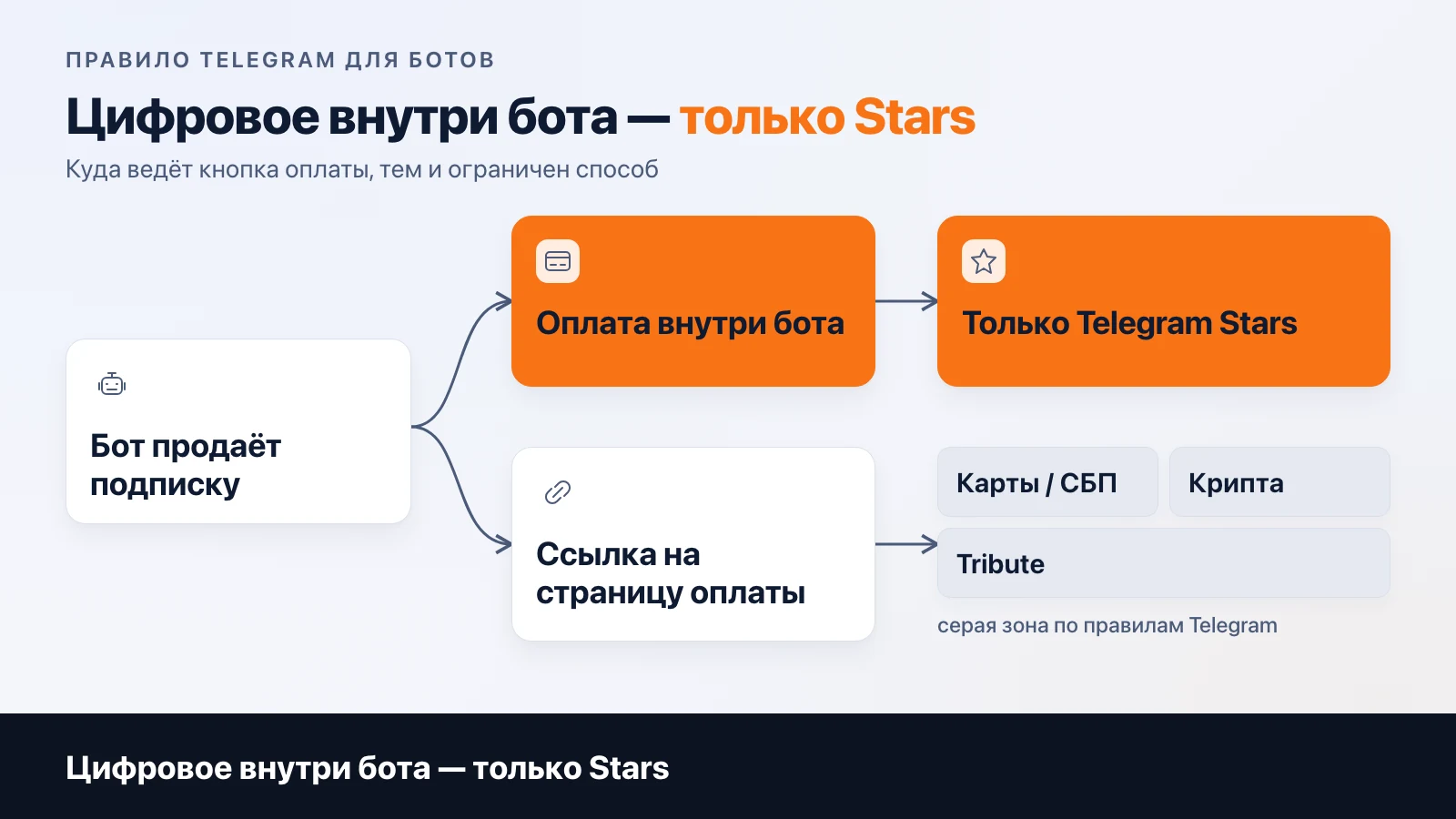
If a bot sells anything digital (a subscription, access, keys), Telegram requires payments inside the bot to be accepted in Stars only. Under Telegram's rules, cards and FPS through YooKassa or any other provider are meant for physical goods; in practice, ruble payments for digital products get collected through a link to an external page. Crypto and Tribute are outside the bot too. Our bot runs all four methods, and two of them account for 97% of payments.
The Telegram rule: digital goods in a bot are Stars-only
The payments documentation for bots states it with no wiggle room: "Payments for digital goods and services must be carried out exclusively in Telegram Stars." And then, separately: a bot must use Stars for digital goods inside Telegram regardless of what other websites, apps, and providers it has. Providers (YooKassa, Stripe, and a couple dozen more) are described as a tool for physical goods and services, and Telegram itself doesn't take a commission on those — the provider does.
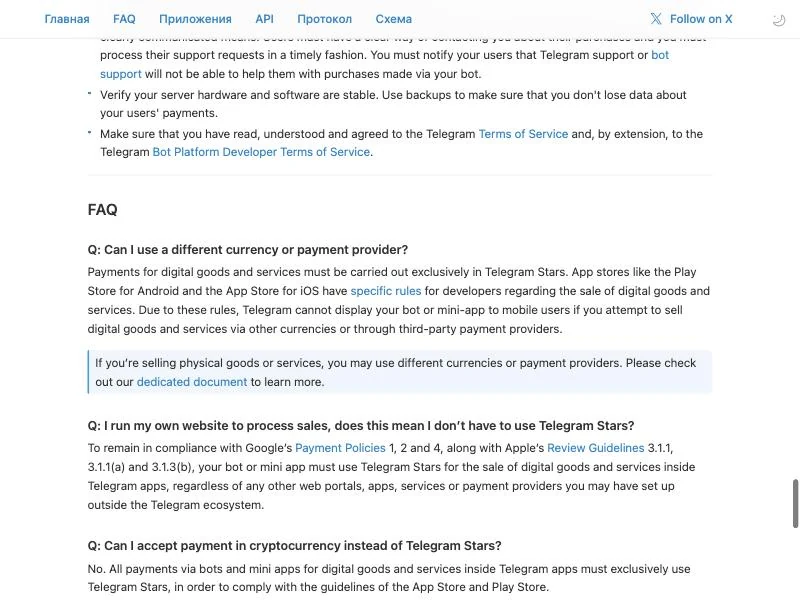
Three questions from the Telegram documentation FAQ, October 30, 2026: another provider, your own payment site, crypto. The answer to all three is the same.
Where this came from: Apple barred bots from taking money for digital goods from iPhone users, and before Stars appeared, the documentation said exactly that: you can't sell digital goods on iOS. Stars settled the question for every platform at once, and the rule became universal.
What this looks like in the market. Most Russian-language subscription bots show a "Pay by card" button that opens the provider's page in a browser. Formally, that's not a payment inside Telegram. Whether it fits the "regardless of any other web portals" rule is for Telegram to decide, not bloggers, and I haven't seen any public statistics on bans for it. But I can't call it an "approved method." It's a method people use knowing the rule exists.
Four methods in one table
| Method | Where the payment happens | Commission | Auto-renewal | What it's good for |
|---|---|---|---|---|
| Telegram Stars | inside the bot, via the Telegram button | Telegram's fee at its exchange rate (clause 6.2.4 of the developer terms) | yes, Stars subscriptions | the only method that fully complies with Telegram's rules |
| YooKassa (cards, YooMoney, SberPay) | through a provider in BotFather or via a link to a payment page | 3.5% on the base plan for services and digital content | not through the bot: recurring charges and pre-authorization holds don't work in this integration | ruble payments, a checkout screen users already know |
| Faster Payments System (FPS) | via a link to the aggregator's page | YooKassa's public rate table has no rate for it; other aggregators set their own | depends on the aggregator; ours supports it on the monthly plan | the cheapest way for users to pay in rubles |
| Crypto (Crypto Bot, TON, USDT) | via a link or through Crypto Pay | check Crypto Pay's documentation, the page has moved | no | users outside Russia who don't want to expose their card |
| Tribute | an external service for subscriptions and donations | 10% per transaction | yes | when you don't want your own payments backend at all |
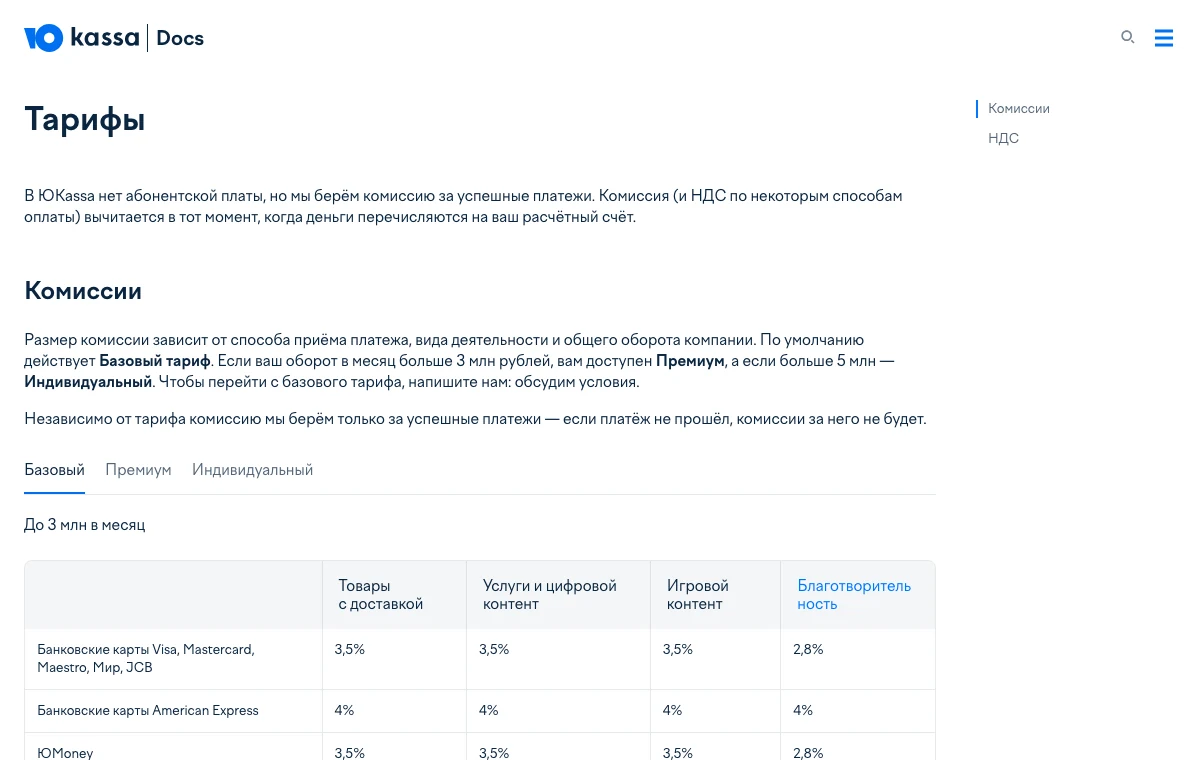
YooKassa's public rate table as of October 30, 2026. There's no FPS row in it: the rate is quoted in the contract.
What matters here for a service, as opposed to a bot with a single button, is auto-renewal. A subscription that doesn't renew itself turns every paying customer into someone you'll have to message a month later. In our breakdown of VPN service economics, renewals bring in two-thirds of revenue. If your payment method can't renew, you lose two-thirds of the money. Against that, the commission is small change.
How people pay in our bot: shares and prices
Our service runs four providers: a ruble aggregator with cards and FPS, Stars, crypto, and Tribute. The price of a month varies by method, and the user sees it on the payment screen: 298 ₽ by card and via FPS, 256 ₽ in the Stars equivalent, 238 ₽ in crypto. Crypto is the cheapest because the commission is lower there and there are almost no refunds.
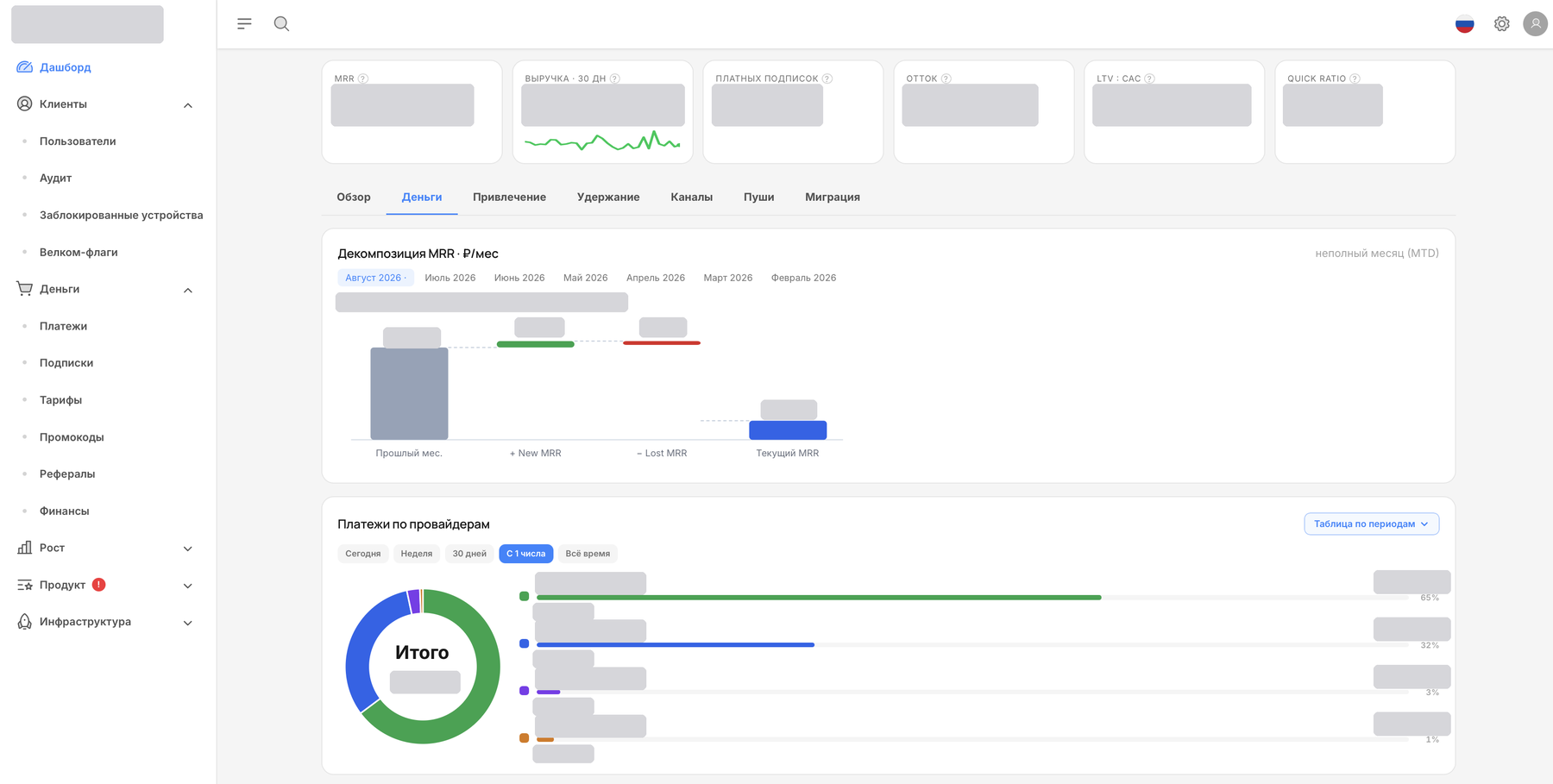
The "Payments by provider" block in the admin panel for a month. The names are hidden, but the proportion is visible: two providers account for 65% and 32% of payments, the other two for 3% and 1%.
The takeaway for us: it was worth wiring up four methods to learn which two we needed. Keeping four from here on is a support question: each has its own refunds, its own errors, and its own "I paid but got no key" emails from users. The two tail providers together bring in less than an hour of sorting out their issues costs us each month. But we're in no hurry to turn them off either: that 4% is people the other two methods didn't work for.
Auto-renewal and cancellation: what the user sees
The most common query alongside "Telegram bot payments" is "how to cancel a subscription in a Telegram bot." That means people can't figure out where to turn it off, so they write to support. For a service, those are support tickets you could have avoided.
With Stars, cancellation lives in Telegram settings, in the subscriptions section: the user turns it off themselves, and the bot learns about it through an event. With ruble payment aggregators, auto-renewal is enabled on the provider's side, and cancellation is a button in your bot that calls the provider's API. If there's no such button, the user goes to their bank and revokes the debit authorization there, and you get a chargeback instead of a cancellation. Tribute manages subscriptions itself; cancellation is inside its own interface.
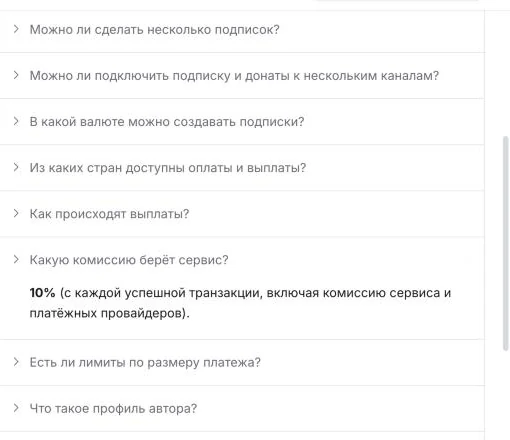
Tribute's fee, from its own FAQ, October 30, 2026. The ten percent already includes the provider, so you don't need a separate payment processor.
We have auto-renewal on the monthly plan via SBP, with Stars, and with Tribute. The 3- and 12-month plans are paid one-time: no renewal needed there. And fewer people forget about the charge and ask for a refund.
What people choose in the calculator
In the ready-made VPN service calculator, payment is split into two lines: "Payment in Telegram" (the bot sells subscriptions and issues keys) and "Payment on the website," with a set of providers. In September and October 2026, the Telegram payment line was selected in 50% of calculations, website payment in 26%. Calculations with website payment also show which providers were picked.
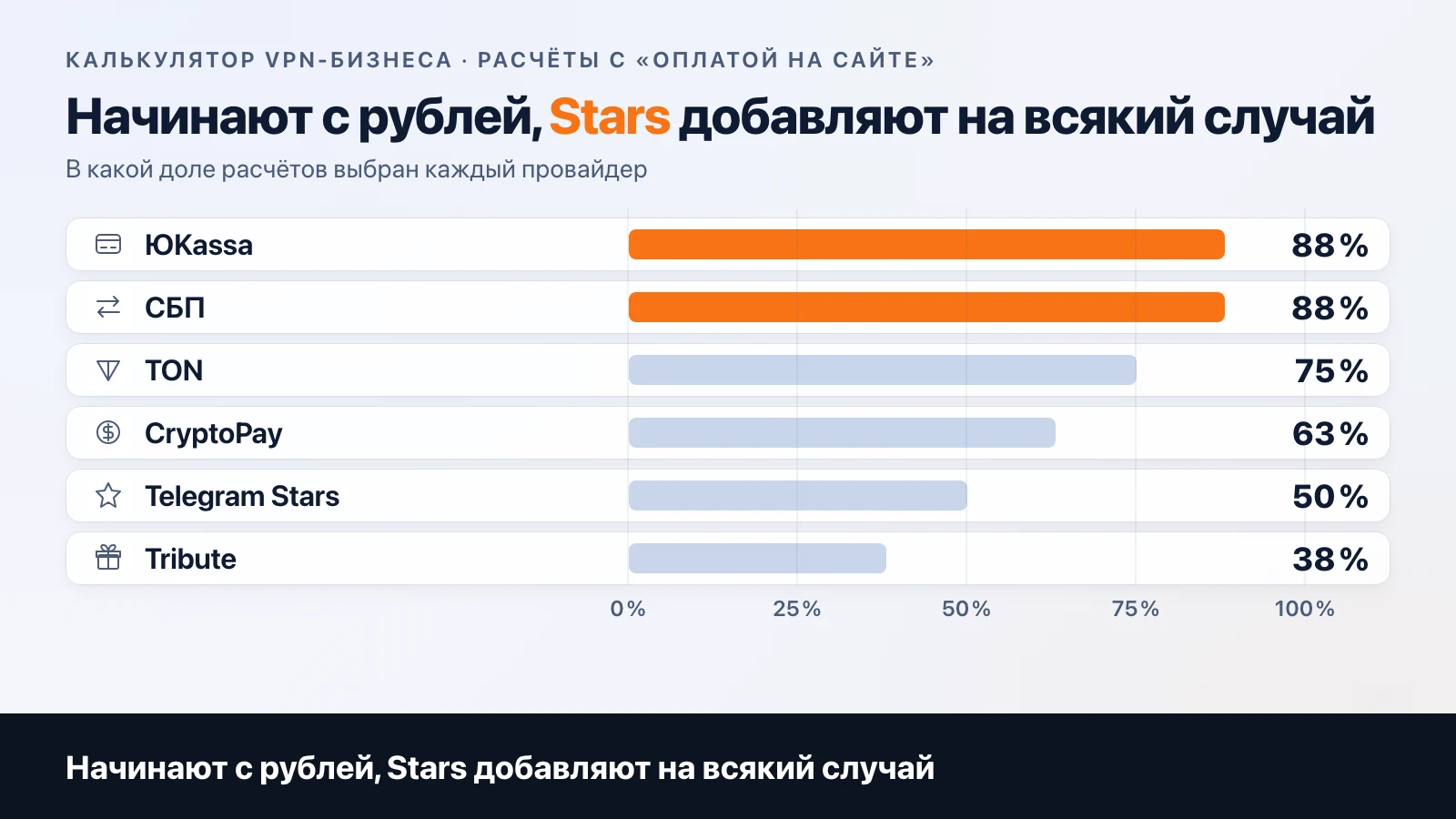
YooKassa and SBP are almost always there, at 88% each. TON and CryptoPay come in at 75% and 63%. Stars in half of calculations, Tribute in 38%. So people assemble exactly the same four we have in place: they start with rubles and add Stars "just in case." You can't predict in advance which button will turn out to be the second-biggest moneymaker: for us the second method brings in a third of payments, and at launch it didn't look like a runner-up.
Three mistakes that cost money
The first: invoicing for a subscription through a provider inside the bot, the way you would for a physical good. That's a direct violation of the rule, and the documentation spells it out in the words "exclusively in Telegram Stars." If you do accept rubles, do it via an external link, knowing it's a gray area.
The second: setting up one payment method and assuming the rest aren't needed. For us, 32% of payments go through a method that seemed secondary at launch. Without it, revenue would be a third lower, and we'd never have known.
The third: not building a cancel button. The query "how to cancel a subscription in a Telegram bot" gets searched more often than "how to accept payments in a Telegram bot." Everyone who can't find the button either writes to you or goes to their bank.
In the ready-made VPN service calculator, Telegram payment and website payment are counted as separate lines, and you can add several providers: that way you can see what each button costs. And what you need to build around the bot to turn it into a service is covered in the article on the layers of a VPN service.
Frequently asked
Can I accept YooKassa payments directly in the bot for a service subscription?
Telegram classifies a service subscription as a digital service, and for those it requires Stars inside the bot. Providers like YooKassa are allowed under Telegram's rules for physical goods. In practice, ruble payments for digital services go through a link to a payment page outside Telegram, and that's a risk area, not an approved path.
What does YooKassa charge?
Under the base rate, 3.5% on bank cards, YooMoney, and SberPay for services and digital content with turnover up to 3 million a month. The exact rate is specified in the contract. There's no SBP fee in the public rate table.
What does Tribute charge?
10% of every successful transaction, including payment provider fees. Payouts twice a month, on the 10th and 25th, with a minimum of 3 000 ₽ to a card.
What does a developer get from Telegram Stars?
A payout at the rate Telegram sets for each star. The rate itself is described in the bot developer terms, section 6.2.4; the payments documentation page doesn't give any numbers.
Do I need an online cash register if payments go through Stars or crypto?
That's a question for your accountant and your legal entity, not for the bot. This article doesn't cover taxes or 54-FZ.
Related articles
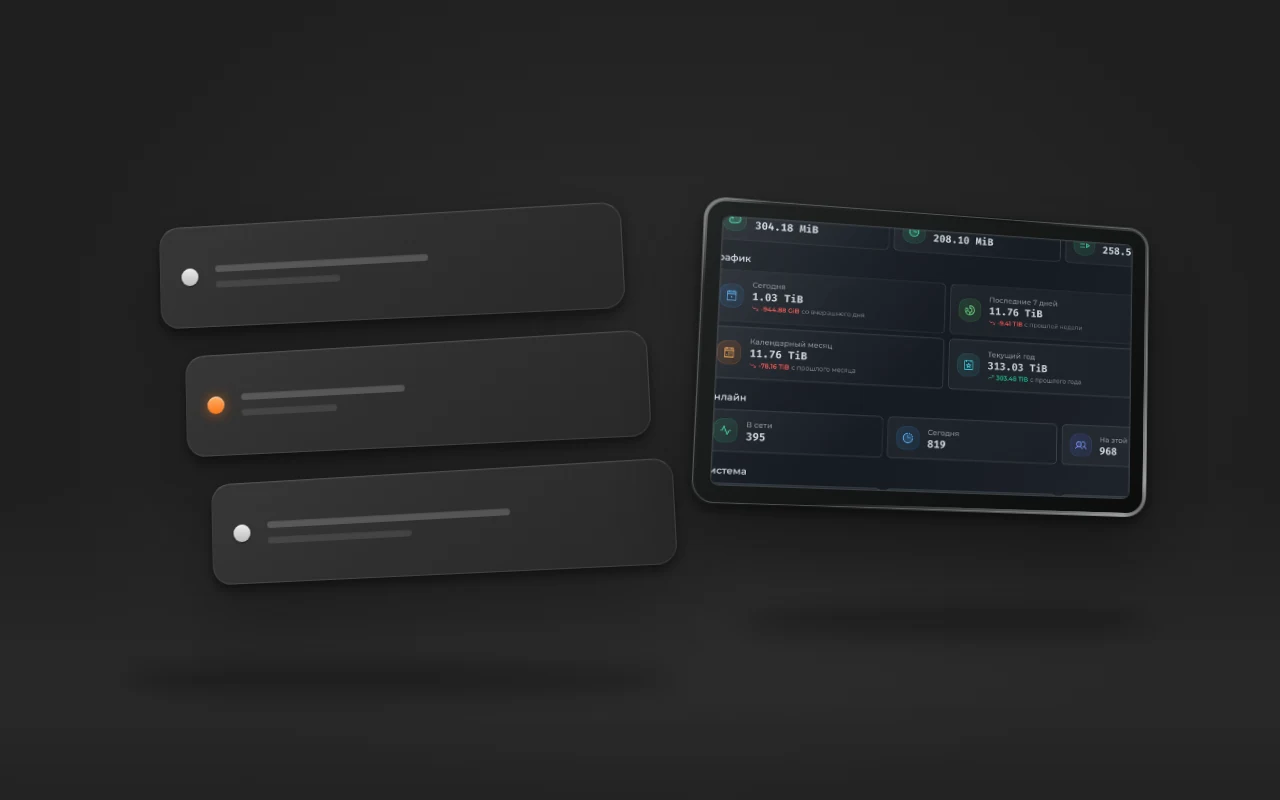
VPN Server Hardware: Which VPS to Pick and How Much It Can Handle
What kind of VPS a subscription-based VPN service needs: bandwidth, traffic limits, CPU. Real numbers from a live service: 79 TiB per month, 395 users online, and what hits its limit first.
Control panel for a VPN service: 3x-ui, Marzban, or Remnawave
A comparison of VPN server panels for selling subscriptions: 3x-ui, Marzban, Remnawave. What our service runs on, what setup includes, and why the config matters more than the panel.
How Much Your Own VPN Service Earns — and When It Pays for Itself
A breakdown of VPN service economics over one month of operation: where revenue comes from, what eats into it from the inside, LTV, CAC, and the threshold below which the whole thing stays in the red.