Control panel for a VPN service: 3x-ui, Marzban, or Remnawave
A VPN service panel is the web interface on your server where you create users, issue keys, and see who has downloaded how much. In this site's DIY VPN service calculator, the "VPN panel setup" line item shows up more often than any other: across September and October 2026, it appears in 82% of estimates. Three panels stand out on the market: 3x-ui, Marzban, and Remnawave. Below they're side by side in one table, with versions and licenses as of October 30, 2026, plus the one our service runs on. And a separate look at what you're actually paying for when you pay "for a panel."
The short answer
For one or two servers and personal use, go with 3x-ui: it installs with a script in an evening, and everything lives in one interface. For a service that sells subscriptions and runs several nodes, choose Remnawave or Marzban: both have nodes, a subscription link, and an API for your backend. Our service runs on Remnawave. But the panel isn't where the real work hides: any of the three installs in an evening, while configs for mobile networks in Russia have to be built by hand on top of whichever one you pick.
What the panel does and doesn't do
The panel manages Xray-core, the engine that keeps VLESS, Trojan, Shadowsocks, and the rest running. The panel itself doesn't encrypt or route anything. It does four things:
- creates users and issues their keys;
- tracks traffic and limits;
- gives the user a single subscription link that the client (Happ, v2rayTun, your own app) uses to pull the server list;
- pushes configs out to nodes when there's more than one.
What it doesn't do: it doesn't take payments, doesn't manage subscriptions by payment date, and doesn't answer support requests. That's what a backend on top of the panel is for — it creates and disables users through the API after a payment goes through. In our breakdown of the layers of a VPN service, the panel is the second of five layers. If you think you're buying a "service" but you're really being sold a "configured panel," you're buying one fifth of it.
Three panels in one table
Data from GitHub as of October 30, 2026.
| 3x-ui | Marzban | Remnawave | |
|---|---|---|---|
| What it is | a web panel for Xray, a fork of x-ui | a "unified GUI" for Xray, Python | an Xray panel on Node.js |
| License | GPL-3.0 | AGPL-3.0 | AGPL-3.0 |
| Latest release | 3.11.0, October 25, 2026 | 0.8.4, January 9, 2025 | 3.4.7, October 22, 2026 |
| Nodes | claimed in the README; inbounds can be cloned to other servers | a separate project, marzban-node | yes, the panel was designed around a fleet of nodes from the start |
| Subscription link | yes | yes | yes, plus a dedicated subscription page |
| Multiple admins | no | work in progress (WIP) | yes |
| Who it's for | yourself and a small group | a service that's already on it | a service that's growing and automating |
| What gives pause | README: "personal use only, not for production" | release cadence | memory: the community cites a 2 GB minimum for the panel |
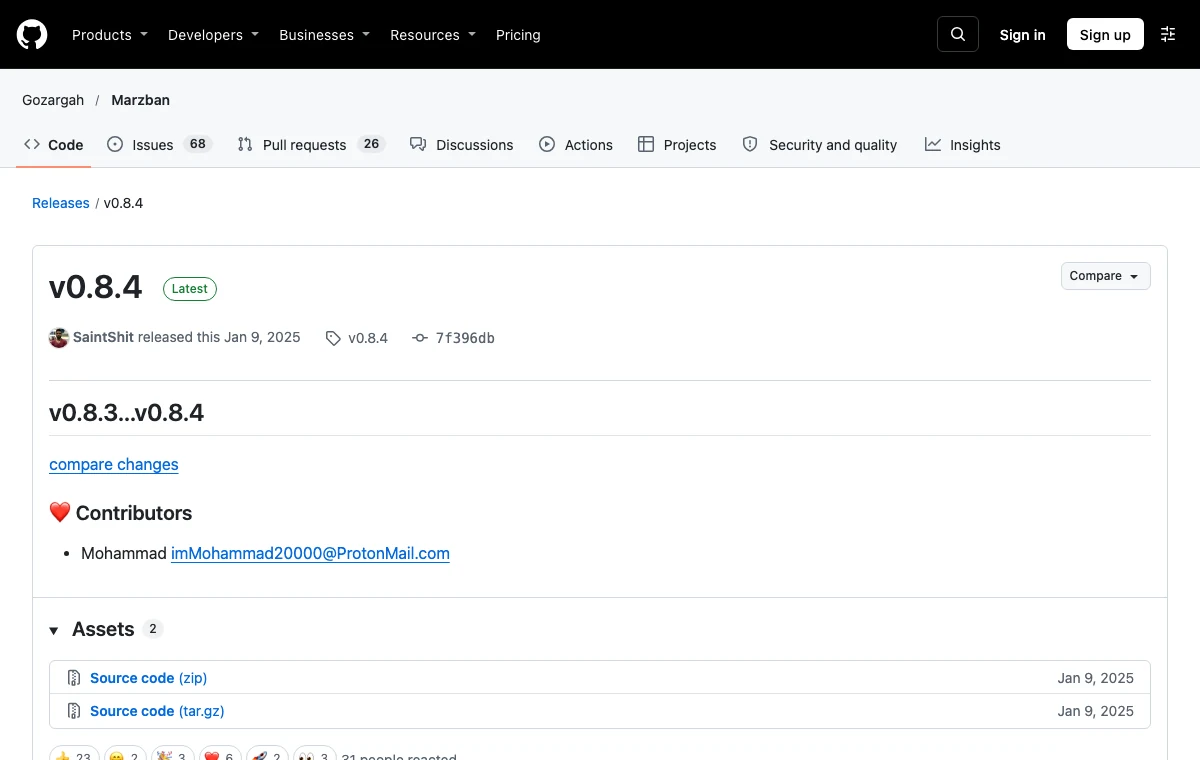
The easiest place to verify it is right where it's stated: the latest Marzban release page as of October 30, 2026.
There's deliberately nothing here about installation. A search for "3x ui install" returns dozens of guides, and they're all the same: a VPS, one command from GitHub, a password. The question isn't how to install it, but what comes after.
3x-ui: a quick start and one line in the README
3x-ui is the most popular panel by search volume: "3x-ui" gets about 24,000 searches a month, five times more than Remnawave. The reason is simple: it installs with a single command, runs entirely in one container, and ships with more than a dozen protocols, including WireGuard and Hysteria.
The line people skip: the project's README states that it's intended for personal use and asks people not to use it in production.
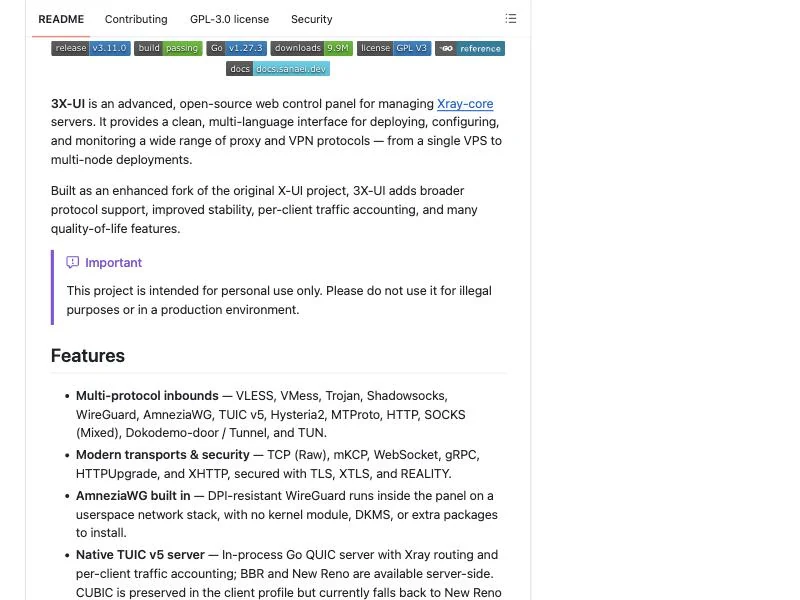
The Important block from the 3x-ui README, October 30, 2026. It sits right below the description, before the feature list. This isn't a legal ban or a technical limitation: 3x-ui has nodes, and subscriptions too. It's the authors' position, and it explains the project's priorities: convenience for a single admin matters more than what a service with thousands of users needs. If I were building a service to sell, I'd take that into account.
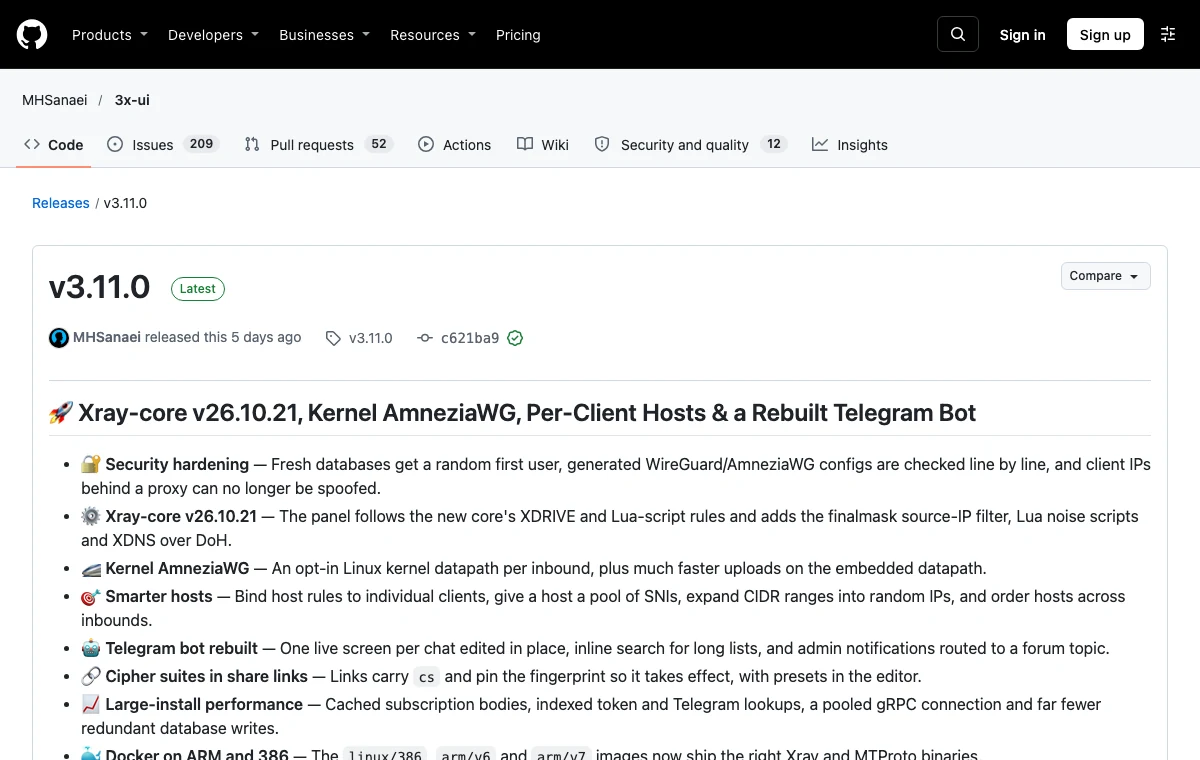
3x-ui's pace is the opposite of Marzban's: release 3.11.0 shipped on October 25, 2026, with a new Xray core and a rewritten bot.
Marzban: Nodes Are There, Release Cadence — Keep an Eye On It
Marzban emerged as an answer to what x-ui lacked for running multiple servers: nodes are a separate component, the user gets one link for all servers, and there's an API. A sizable share of Russian-language services still runs on it, and for them migrating anywhere is extra work with no payoff.
What to look at before choosing: the latest release, 0.8.4, is dated January 9, 2025 — almost two years without releases; multi-admin support is marked "in progress" in the README. The panel is alive, but if you're starting from scratch in the fall of 2026, it's worth comparing how fast issues get closed in Marzban versus Remnawave. For an existing service, that's not a reason to migrate. For a new one, it's a reason to choose carefully.
Remnawave: What Our Service Runs On
Our service runs on Remnawave. The panel is young, built on Node.js, and was designed from the start as a hub for a fleet of nodes: the panel is separate, the nodes are separate, and configurations are described in profiles rather than clicked through server by server.
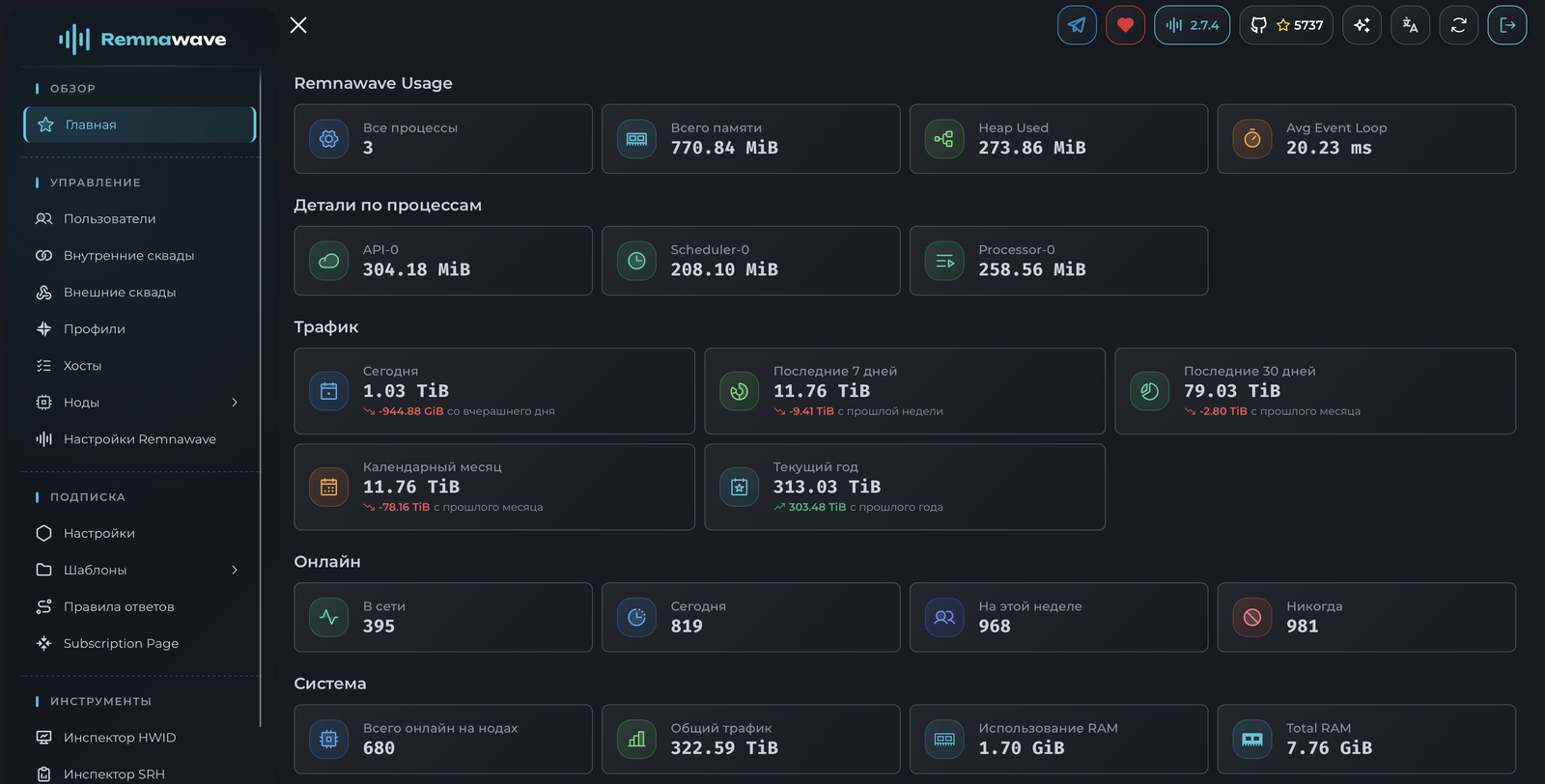
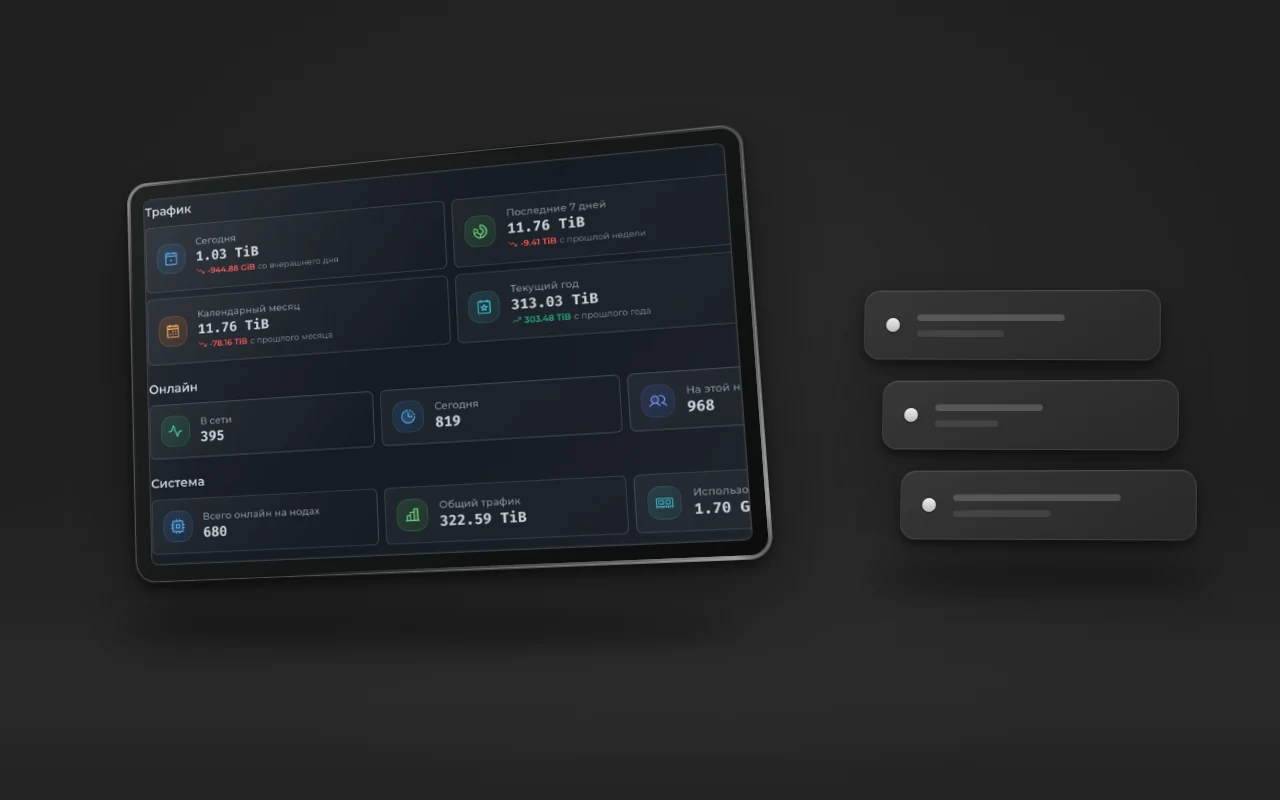
This is what the panel looks like in our setup: about 80 TiB of traffic over 30 days, nearly 400 people online at the moment of the screenshot. The panel itself spends less than a gigabyte of memory on all that.
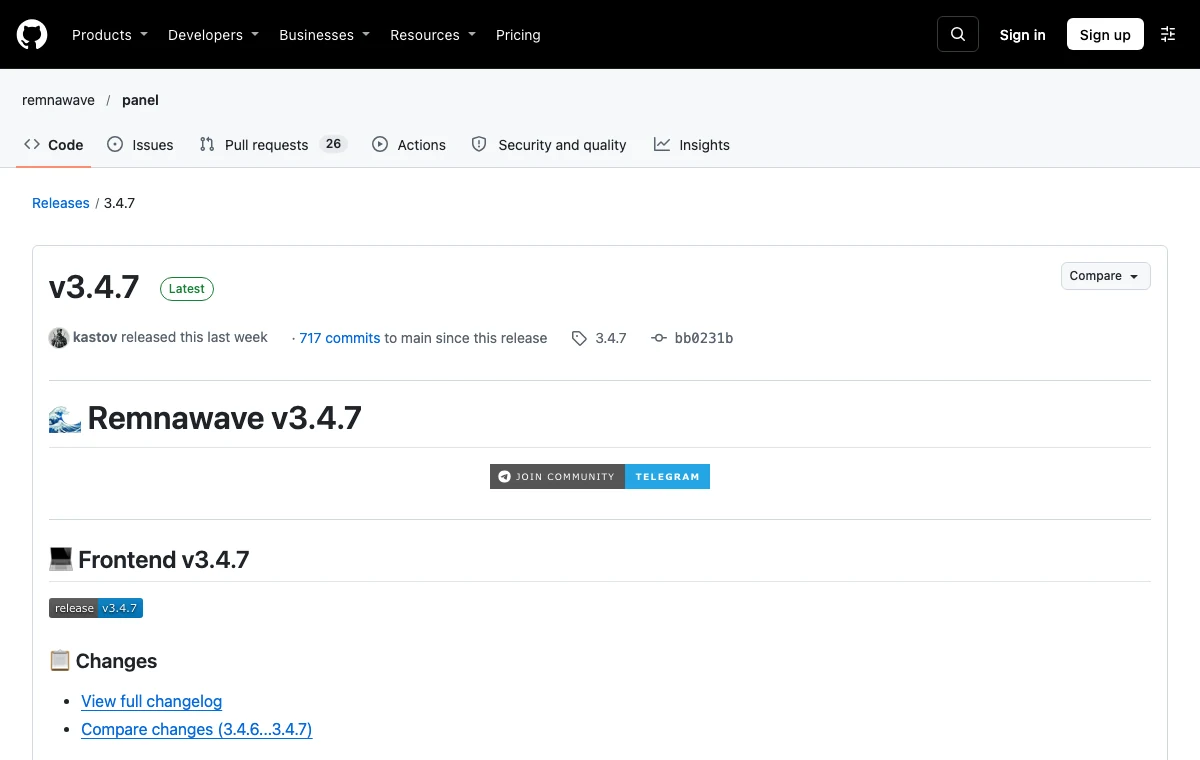
Release 3.4.7 dated October 22, 2026. Since then, main has already gained more than 700 commits: the project moves fast.
What's worth knowing before you choose. Remnawave asks for more resources than 3x-ui: according to the community, a minimum of 2 GB of memory for the panel, and that's without the nodes. Configs are written as text rather than through a form, which is more flexible and takes some getting used to on day one. And the project changes actively: version 3.4.7 came out on October 22, 2026, and you'll have to update regularly.
Why we chose it over Marzban anyway: we needed nodes under a single panel, an API for our own backend with payments, and multiple admins. All of that was already covered, not "in progress."
What People Pick in the Calculator: the Panel in 82% of Estimates
The turnkey VPN service page has a calculator: you assemble a package from apps, backend, panel, and website and see the price range. The estimates come into our work chat with no names attached. Here's what people selected in them in September and October 2026.
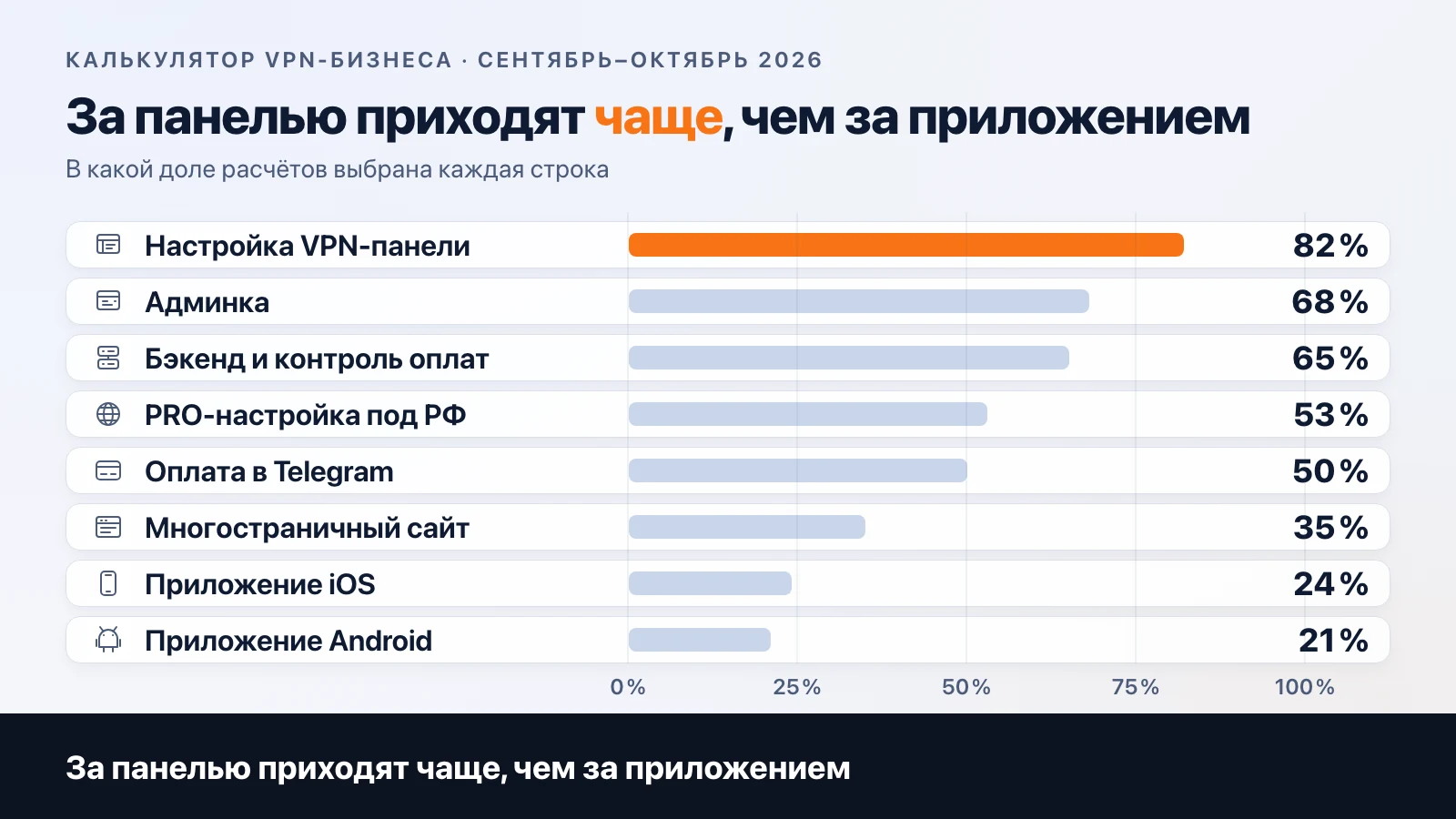
Panel setup is in 82% of estimates. Next come the admin panel (68%), backend with payment control (65%), and setup for Russian mobile networks (53%). iOS and Android apps, which seem like the main thing at first glance, get picked less often: 24% and 21%. The most common minimal package is "panel plus admin panel," with no apps at all: people plan to hand out keys through Happ or v2rayTun and steer clear of store moderation.
What this says about the market: people come for the panel more often than for the app. And this is a case where the buyer is right: a panel with the right configs and a backend with payments give you a working service, and the app can be added later, once the first paying customers show up.
What's Included in "Panel Setup" and Why There's a Separate "For Russia" Line
The calculator has two separate line items: "VPN Panel Setup" and "PRO Setup for Russia." The first is panel installation, protocols, nodes, the subscription link, and basic configs. For any of the three panels, that's one or two days of work.
The second is the reason this article exists. Configs from the Xray documentation come up on Wi-Fi and drop on mobile data: carriers have their own filtering, and basic settings don't account for it. This doesn't depend on the panel. 3x-ui, Marzban, and Remnawave will all apply a non-working config equally faithfully. Setup for mobile networks is separate work on top of the panel, and in the calculator it costs more than the panel itself.
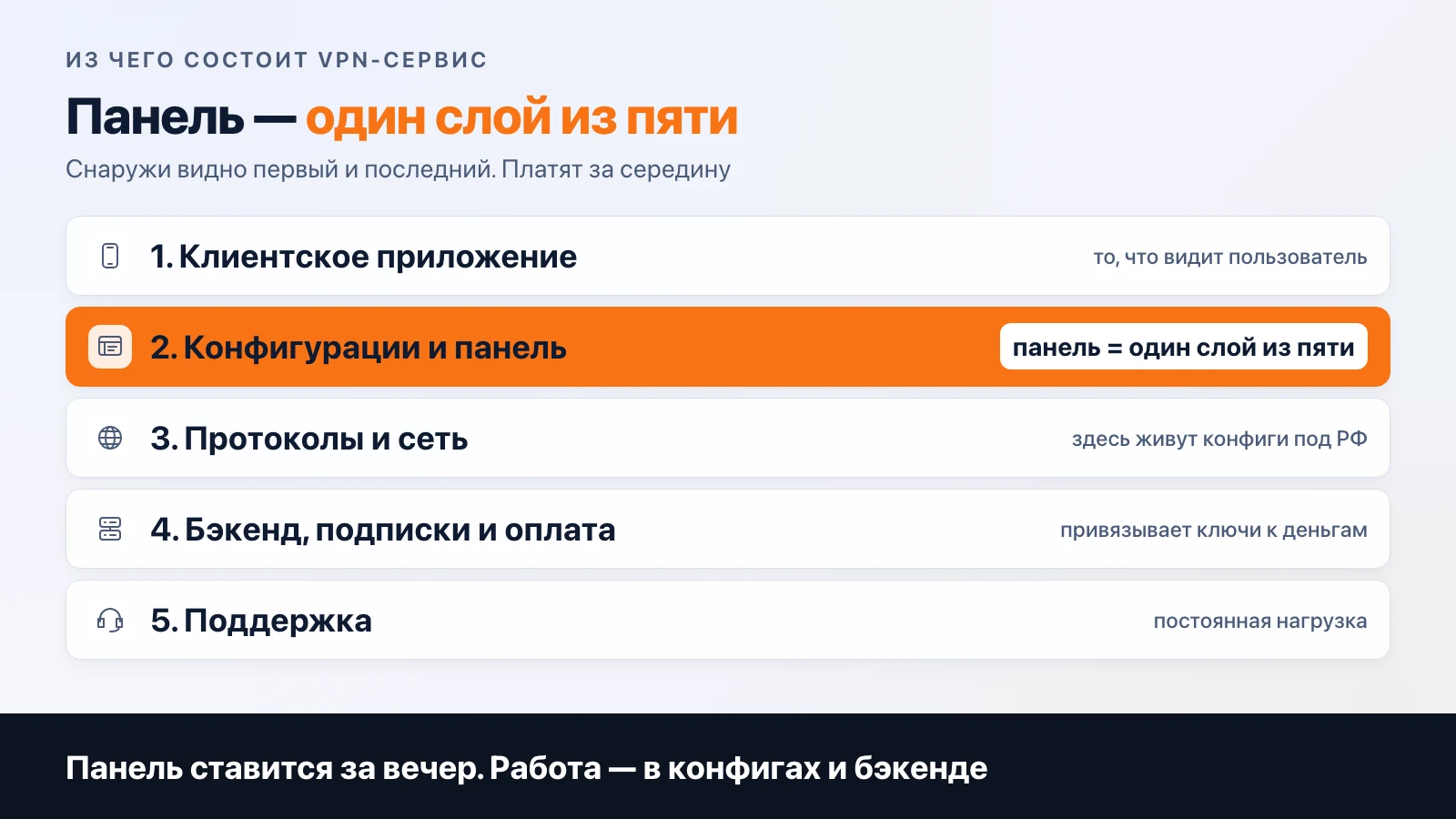
So if you're deciding where to spend time at launch: not on comparing panels. Any of the three will do. Spend it on configs and on the backend with payments. How the economics of such a service add up and when it starts making money is covered in the article on revenue and expenses.
To work out what a panel with mobile-network configs costs, use the calculator on the turnkey service page: these are separate line items there, and you can take them without any apps.
Frequently asked
Can you sell subscriptions on 3x-ui?
Technically yes: it has nodes and a subscription link. But the project's README explicitly asks you to use it for personal purposes only and not to put it into production. For a service that sells subscriptions, Remnawave or Marzban makes more sense.
How is Remnawave different from Marzban?
Both panels support nodes and give the user a single subscription link. Remnawave is younger and ships releases more often: 3.4.7 came out on October 22, 2026. Marzban's latest release, 0.8.4, is dated January 9, 2025. Remnawave is heavier on memory: the community cites a minimum of 2 GB for the panel.
Do you need a panel if you have your own app?
Yes. The app doesn't issue keys on its own: it gets configs either directly from the panel via the subscription link or from a backend that calls the panel through the API and ties the keys to payments.
How many servers do you need at launch?
One for the panel and one or two for nodes. Our service has more than ten, but that's after a year of operation and traffic growth, not a requirement for launch.
Why don't the configs from the documentation work on mobile internet in Russia?
Filtering on mobile carriers works differently than on Wi-Fi, and the default protocol settings don't account for it. It's separate work on top of any panel. In our calculator it's called exactly that: “PRO setup for Russia.”
Related articles
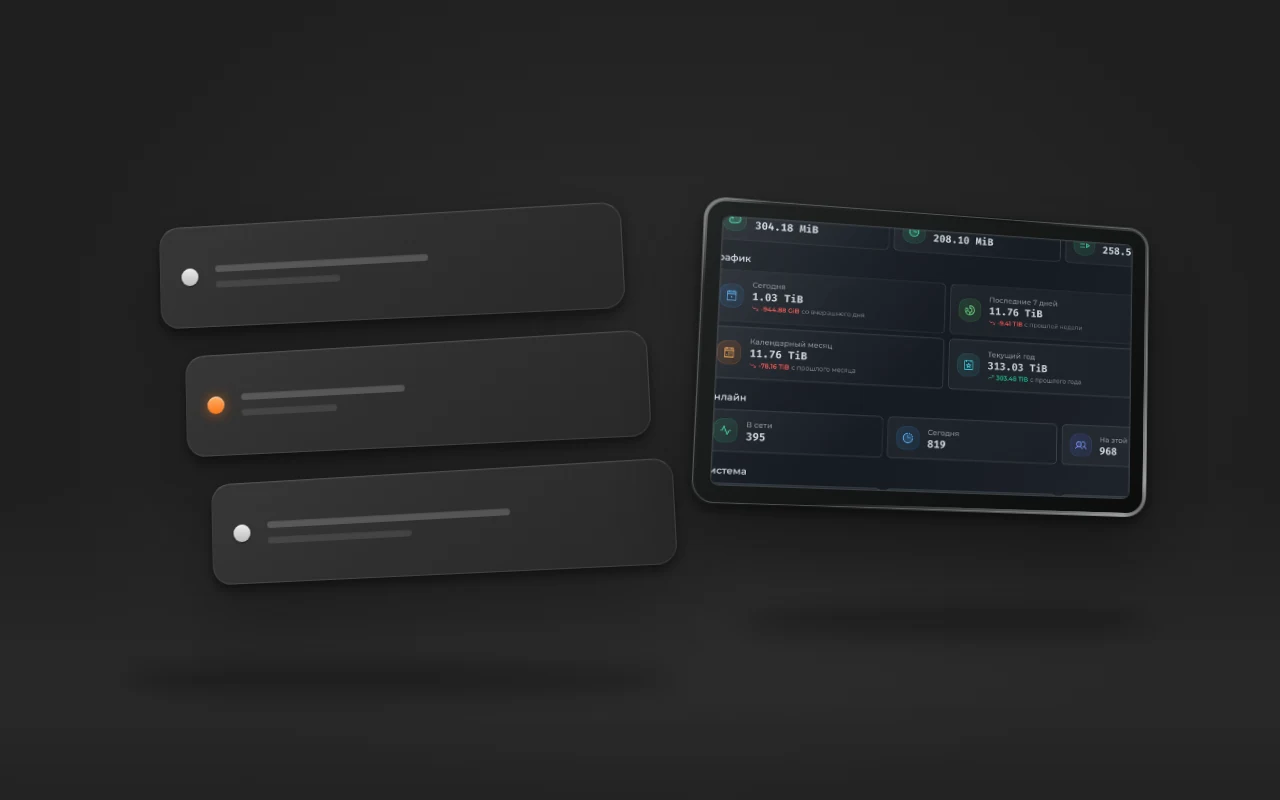
VPN Server Hardware: Which VPS to Pick and How Much It Can Handle
What kind of VPS a subscription-based VPN service needs: bandwidth, traffic limits, CPU. Real numbers from a live service: 79 TiB per month, 395 users online, and what hits its limit first.
Taking payments in a Telegram bot: Stars, YooKassa, SBP, or crypto
How to take subscription payments in a Telegram bot: Telegram's rule on Stars, YooKassa and Tribute fees, and crypto. How people actually pay in our bot.
How Much Your Own VPN Service Earns — and When It Pays for Itself
A breakdown of VPN service economics over one month of operation: where revenue comes from, what eats into it from the inside, LTV, CAC, and the threshold below which the whole thing stays in the red.